
Top Signs You Need Roofing Service – Don’t Ignore These
A ceiling stain doesn’t mean your roof is leaking now. It means your roof has been leaking long enough for water to travel through insulation, across a joist, and soak through drywall, a process that typically takes weeks to months. By the time you see the stain, the damage is already done. The same pattern holds for nearly every roofing problem: what you notice is a receipt, not the event itself. If you’d rather skip the detective work, call Tilehurst Roofing home at (945) 303-9821 and we’ll walk the roof with you.
Key Takeaways:
- Visible signs are almost always late-stage; the real damage started months earlier
- Los Angeles UV exposure ages shingles faster than cooler climates, so a 15-year-old roof here behaves like a 20-year-old roof elsewhere
- You can safely check your attic on a dry day and take photos that help a contractor diagnose issues before scheduling a visit
- Early-stage signs cost hundreds to fix; late-stage signs often mean replacement
The Ceiling Stain Is the Last Thing That Happens
Here’s the timeline nobody explains. Water finds a small opening at the roof surface, often around a pipe boot or a nail that’s worked loose. It seeps into the underlayment, then the decking. From there it travels laterally along a joist until gravity pulls it down through the insulation and into the drywall. By the time it browns your ceiling, the leak has been active for weeks, sometimes months. The stain itself is the smallest part of the problem. What you can’t see is damp decking, saturated insulation, and the beginning of mold growth in a closed attic space.
In Los Angeles, this timeline compresses. Our dry-season rains come hard and fast, but between storms, attics bake at 130 degrees or more. That heat dries the surface while moisture lingers deep in the decking and insulation, which means the visible stain often shows up long after the actual leak event. We’ve opened ceilings in Sherman Oaks where a single December storm had been quietly rotting the decking for nine months before the homeowner saw a watermark. The fix at that point involved replacing decking, not just a shingle.
Early-Stage Signs Most Homeowners Walk Past
If you catch these, you’re ahead of 90% of the homeowners we meet. They’re easy to miss because they don’t announce themselves. They require looking, not just noticing.
- Lifting nail heads on ridge caps. The ridge cap is the row of shingles running along the peak of your roof. Nails that work themselves up through the cap create a tiny funnel for water. You’ll see small bumps or exposed nail heads if you look along the ridge line from the ground or a ladder.
- Hairline cracks in pipe boot flashing. Every plumbing vent pipe through your roof has a rubber boot around it. Los Angeles sun cooks that rubber. After five to seven years, it develops fine cracks that let water in slowly. This is one of the most common repair calls we make, and it’s a $200 – $400 fix when caught early.
- Granule loss visible in a gutter scoop. Clean out a section of gutter and look at what’s in it. A fine layer of dark granules is normal wear. A thick, gritty accumulation that looks like coarse sand means your shingles are shedding their UV protection faster than they should. On an LA roof, that’s often the first sign that replacement is closer than the shingle warranty suggests.
None of these require getting on the roof. Binoculars from the yard, a ladder against the gutter, and five minutes of attention will tell you a lot. If you’re not sure what you’re looking at, snap photos and send them to us. We’ll tell you honestly whether it’s worth a visit or something to watch for another year.
Mid-Stage Signs: The Damage Is Already Inside
By mid-stage, water has reached the deck and the attic. The roof isn’t just aging; it’s actively failing in specific spots. These signs mean you need Roof Repair in Los Angeles sooner rather than later, because every additional rain event expands the damage.
- Daylight visible in the attic. On a bright day, go into your attic and turn off the lights. Let your eyes adjust. If you see pinpricks or slivers of daylight coming through the deck, water can get in those same spots. This is the single most reliable indicator of a roof that’s compromised in multiple places, and it costs nothing to check.
- Soft decking underfoot. If you walk carefully on the attic joists (never between them) and press on the decking with a gloved hand, a healthy deck is solid. A water-damaged deck feels spongy or gives slightly. Soft decking means the plywood or OSB has absorbed water long enough to begin delaminating. This is not a repair situation; affected sections have to be cut out and replaced.
- Musty smell in upper rooms. That attic smell that drifts down into bedrooms isn’t just stale air. It’s usually mold or mildew growing in insulation that’s been damp for a while. By the time the smell is noticeable, the moisture problem has been active for weeks.
One thing we tell every Los Angeles homeowner: the attic is the only place you can see the underside of your roof without removing anything. It’s the single most informative inspection you can do yourself, and it takes ten minutes on a dry day with a flashlight.
Late-Stage Signs: When Replacement Outweighs Repair
Some roofs reach a point where patching is like putting a bandage on a sunburn. The whole system is compromised, and continuing to repair individual spots costs more per year than replacing the roof once. These are the signs we look for when we assess whether Roof Replacement in Los Angeles is the more cost-effective path.
- Sagging ridge line. The ridge should run straight and level. A dip or wave in the line means the deck structure underneath has been compromised by moisture and possibly rot. This is structural, not cosmetic. It won’t straighten itself out.
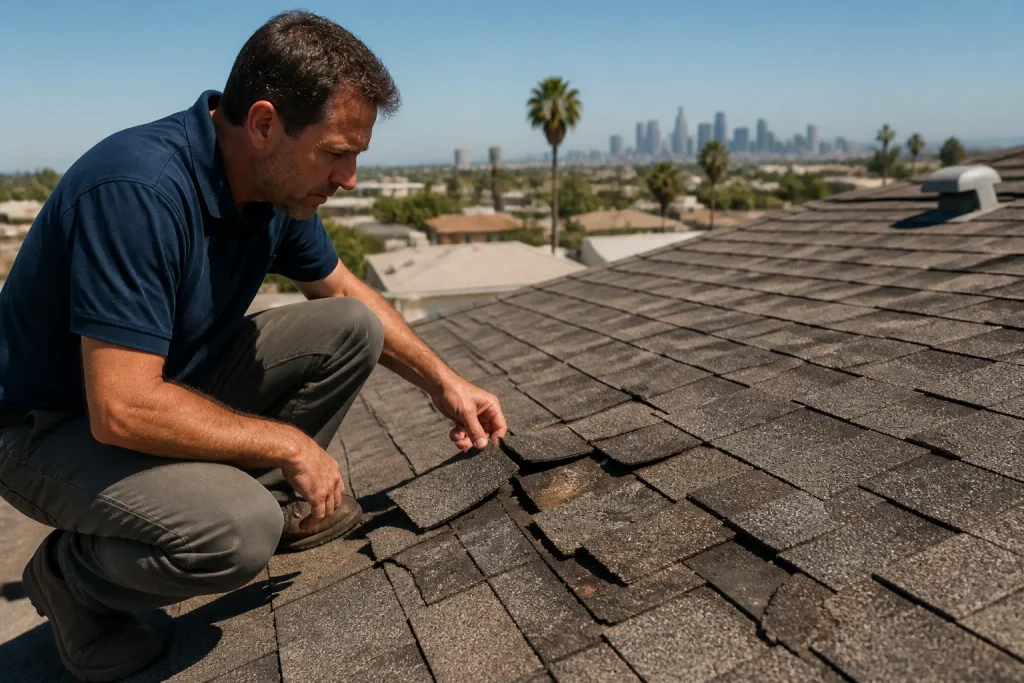
- Widespread shingle cupping. Cupping is when shingle edges curl upward like a shallow bowl. In Los Angeles, UV degradation drives this faster than rain does. Once cupping is visible across large sections of the roof, the shingles have lost their flexibility and their weather resistance. Repairing them doesn’t work because adjacent shingles are in the same condition.
- Multiple active leak points. One leak is a repair. Two or three leaks in different areas, especially after different storm events, means the roof system has failed in its fundamental job. At that point, the money you’d spend chasing repairs would cover a meaningful portion of a full replacement.
We never push replacement when repair is still viable. But we also don’t let a homeowner throw good money at a roof that’s already past its useful life. The honest conversation starts with what we see in the attic and on the deck, not with what a commission target says.
Why LA’s Climate Creates Its Own Failure Pattern
Los Angeles doesn’t get the rain volume of the Pacific Northwest, but it gets something arguably worse for shingles: relentless UV. Asphalt shingles are designed to expand and contract with temperature swings while granule coating blocks ultraviolet light. Here’s what actually happens over a decade or more of LA sun.
UV breaks down the asphalt binder that holds the shingle together. The shingle gets brittle. It can’t flex with normal thermal expansion, so it cracks at stress points, around fasteners, at the shingle edges, and along the ridge where movement is greatest. Granules fall off because the degraded asphalt can’t hold them. Once enough granules are gone, the shingle’s sun protection is gone, and the degradation accelerates.
The practical takeaway: a 15-year-old asphalt roof in Los Angeles often performs like a 20-year-old roof in Portland. That’s not a sales pitch; it’s material science. It’s also why we recommend visual inspections more often here, particularly before the winter rain season. The window between “looks fine” and “needs work” is shorter in this climate than most homeowners expect.
The Attic Inspection You Can Do Safely
You don’t need to get on your roof to know whether you need roofing service. You need a ladder, a flashlight, and a dry day. Here’s the sequence we recommend, and we’ve used this exact checklist on Roofing Company in Los Angeles walkthroughs for years.
- Turn off the attic light. Let your eyes adjust for 60 seconds. Look for any daylight penetration anywhere in the deck. Mark those spots mentally or photograph them.
- Sweep the beam along every seam and joint. Ridge lines, valleys, pipe penetrations, chimney edges. Look for dark staining on the underside of the deck. A dark shininess means water has been there. A chalky white residue means it’s been there repeatedly.
- Check insulation for compression. Water-soaked insulation gets heavy and mats down. Compare sections. If one area looks flattened or has visible water spots, that’s a leak path.
- Photograph everything. Wide shots of the attic, close-ups of any staining, daylight, or decking irregularity. Send these to us or any contractor you’re considering. Good photos save a diagnostic trip and help us give you a realistic price range before we even arrive.
This takes ten minutes and costs nothing. It’s the difference between catching a pipe boot crack for a $300 repair and discovering a rotted deck section that requires a $2,500 structural patch. We pulled a deck section out of a home in Studio City last month where a homeowner had been watching a ceiling stain “spread slowly” for six months. By the time we opened it, the deck was soft over a four-foot span and the insulation below was a sponge. The repair was still manageable, but it was three times what it would have been if they’d done the attic check when the stain first appeared.
When to Call a Pro
Some things are worth your time, and some things aren’t. Here’s our honest take. Call a professional if you see a sagging ridge line, water staining around a chimney, or daylight in the attic. Those are structural or systemic issues, and the cost of a wrong guess is measured in thousands. Call a professional if you have steep-pitch roof sections, a tile roof, or a two-story with a difficult access point. Falling off a roof is a life-changing injury, and it’s not worth saving a few hundred dollars. Call a professional if you’ve already patched the same area once and it’s leaking again. Repeat leaks mean the underlying cause wasn’t addressed.
If you’re in Los Angeles and you’ve noticed any of the signs above, we’re happy to help. Roof Repair in Los Angeles is what we do, and we give you a written price before any work starts. Call (945) 303-9821 and we’ll schedule a time that works for you.
The Bottom Line
The signs you notice last are the ones that have been developing longest. Ceiling stains, musty smells, and soft decking are receipts for damage that started months earlier. The cheapest and easiest roofing service you’ll ever get is the one you catch early: a pipe boot replacement, a few ridge cap nails tapped down, a section of flashing resealed. The most expensive is the one you ignore until the deck rots.
Twenty minutes of attention now beats a five-figure replacement later. Check your attic on a dry day. Look at your ridge line from the yard. Scoop a gutter. If anything looks off, take photos and call us. If you’re in Los Angeles and need help, Tilehurst Roofing offers free estimates, call (945) 303-9821.
Frequently Asked Questions
A roof needs replacement when the damage is widespread or structural: sagging ridge lines, shingle cupping across large sections, or multiple leak points in different areas. It needs repair when the problem is isolated: one pipe boot, one section of flashing, one area of granule loss. The fastest way to tell is an attic inspection. If the deck is solid and the stains are localized, repair is usually the right call. If the deck is soft in multiple spots or daylight shows through in several places, replacement becomes the more cost-effective option. Call (945) 303-9821 for an honest assessment with a written price before any work starts.
Most asphalt-shingle repairs in Los Angeles run $300 to $900 depending on the scope. A simple pipe boot replacement is typically $200 to $400. Flashing repairs around a chimney run $400 to $800. A section of decking replacement with new underlayment starts around $1,200 and goes up with the size of the affected area. Full replacement is a different conversation, usually $12,000 to $25,000 for a standard LA home depending on size, pitch, and material choice. We put the exact price in writing before any work begins, and we don’t change it at the door. Call (945) 303-9821 for a free estimate.
No. We give a written price before any work starts, and that’s the price you pay. If we open a section and find additional damage beneath the deck, we stop, show you what we found, and get your written approval on any adjusted scope before proceeding. You will never be surprised by a bill. This is the way Greg Holloway has run Tilehurst Roofing since 2000, and it’s a condition every Kingswell family company operates under. Call (945) 303-9821 to schedule your free estimate.
Most standard repairs, pipe boots, flashing, small shingle patches, are completed in a single day. Larger repairs that involve decking replacement or underlayment work typically take two to three days. Full replacement for an average Los Angeles home usually runs five to seven working days, weather permitting. We’ll give you a clear timeline when we provide the written estimate, and we show up in the window we gave you. Call (945) 303-9821 and we’ll work around your schedule.
Written by Greg Holloway, Owner at Tilehurst Roofing, serving Los Angeles since 2000.
Need Roofing Help?
Call Tilehurst Roofing - licensed & insured, here with fast after-hours help in Los Angeles.
(945) 303-9821