
5 Mistakes to Avoid With Roofing Company
The five mistakes that cost Los Angeles homeowners the most money aren’t about picking the wrong shingle color. They’re procedural errors that happen before a single nail gets driven: skipping permit checks, accepting verbal quotes, overpaying upfront, misreading warranty fine print, and never asking who actually shows up to do the work. Fix these five things and you’ll avoid about 90% of the horror stories we hear. If you’d rather skip straight to getting a written quote, call (945) 303-9821 and we’ll walk you through it.
The most expensive roofing mistake in Los Angeles doesn’t happen on your roof. It happens at your kitchen table when you sign a contract with no warranty in writing, no permit line item, and no cancellation clause. We’ve torn off roofs in Highland Park and Westchester where the previous contractor did decent shingle work but left the homeowner legally exposed because the process was sloppy. The shingles weren’t the problem. The paperwork was.
1. Skipping Permit Verification
LA County requires a building permit for full roof replacements, and many cities inside the county, including Los Angeles proper, require one for structural repairs too. A contractor who tells you a permit “isn’t necessary” or “will just slow things down” is telling you they’d rather not have an inspector look at their work. That should stop you cold.
Here’s what an unpermitted roof actually costs you. Your homeowner’s insurance company can deny a claim for damage related to unpermitted work. When you sell the house, the unpermitted roof shows up in title searches and disclosures, and buyers will either walk or demand a price reduction. In some Los Angeles neighborhoods, we’ve seen unpermitted roofs knock $15,000 to $25,000 off a sale price because the buyer’s lender flagged it. That’s not a hypothetical. That’s a line item on a closing statement.
The fix is simple: ask the contractor to show you the permit before work starts. Any legitimate roofing company in Los Angeles pulls permits as standard practice and builds the permit cost into the written estimate. If the permit fee isn’t in the quote, ask why not. Then ask again.
2. Accepting a Verbal Quote
A handshake quote is worth exactly what it’s printed on, and it isn’t printed on anything. In California, oral contracts for construction work are actually enforceable up to a point, but good luck proving what was said when the price changes at the door. A written quote isn’t just paperwork. It’s your only real protection against the classic “we found rot, so it’s going to be another four grand” conversation.
Every Los Angeles roofing agreement should include specific clauses before you sign. Look for these five:
- A fixed price for the named scope of work, including tear-off, hauling, and disposal fees. No vague “additional work to be billed later” language.
- A permit line item showing exactly what’s being paid to the city or county, and who’s responsible for pulling it.
- A warranty clause in writing that states what’s covered, for how long, and what the contractor will do if a repair fails inside that window. Not “we stand behind our work.” Actual terms.
- A change-order process that requires written sign-off from you before any extra cost gets added. If it’s not written down, it didn’t happen.
- A cancellation clause that spells out your right to cancel, especially if financing is involved.
We put every one of those in writing before work starts. The written price is in your hands before a crew ever pulls up, and the written guarantee on every repair is delivered before the crew leaves. If a repair fails inside the guarantee period, we return at no charge under the 365-Day Done Right Promise. That’s not a “trust us” clause. It’s a “here’s our signature on it” clause.
3. Paying Too Much Upfront
California law caps the deposit a contractor can collect on a home improvement project at 10% of the total contract price or $1,000, whichever is less. That’s not a guideline. It’s Business and Professions Code section 7159, and any contractor asking for more before work begins is either breaking the law or doesn’t know the law. Neither option is good.
We’ve talked to homeowners in Van Nuys and Echo Park who handed over 30%, 40%, even 50% deposits to contractors who then slowed to a crawl or disappeared. Once a contractor has most of the money, the leverage flips. The job that was “two weeks” becomes two months, and you’re stuck because you can’t afford to walk away from the money you already paid.
The legitimate way to structure payment on a roof replacement in Los Angeles is milestone-based, not percentage-frontloaded. A reasonable schedule looks something like: a deposit within the legal cap, a progress payment when materials are delivered and work is underway, and the final payment only after the job passes inspection and you’ve walked the roof with the crew. Anyone demanding more than the legal cap upfront is telling you who they are. Believe them.
4. Conflating the Manufacturer Warranty With the Workmanship Warranty
This is the mistake that creates the angriest phone calls we get, usually about 14 months after installation. Homeowners read “lifetime warranty” on a shingle brochure and assume it means the roof will never leak. It doesn’t mean that. It means the manufacturer will replace defective shingles. It does not mean the manufacturer will pay for the labor to replace them, and it absolutely does not cover leaks caused by installation errors.
The two warranties are separate. The manufacturer warranty from companies like IKO or Tamko covers defects in the shingle itself. The workmanship warranty covers whether the contractor installed everything correctly. If the crew botched the flashing and water gets in, the manufacturer will say “not our problem” and they’ll be right. If the contractor’s workmanship warranty is verbal, vague, or already expired, you’re paying for the fix yourself.
Here’s what to verify in writing before signing:
- Who backs the workmanship warranty? The contractor, not the shingle manufacturer.
- How long does it last? One year is common. Five years is better. Get it in writing either way.
- What exactly does it cover? Leaks from installation errors, not just materials.
- What happens if a repair fails inside the warranty period? We answer that question before the job starts. The 365-Day Done Right Promise means a full year of documented accountability, and if a repair fails, the crew comes back at no charge. That’s the floor, not an upsell.
If a roof repair in Los Angeles goes wrong, you want the answer to “who fixes this?” settled in writing before you need it. Not discovered the first time it rains.
5. Checking the Company’s License but Not the Subcontractors’
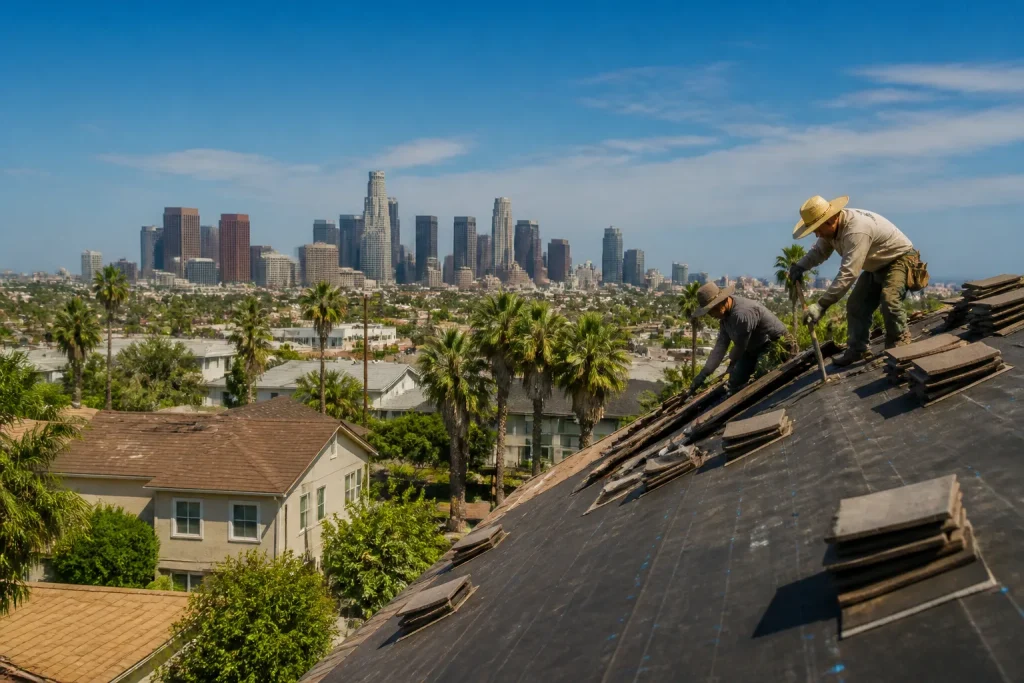
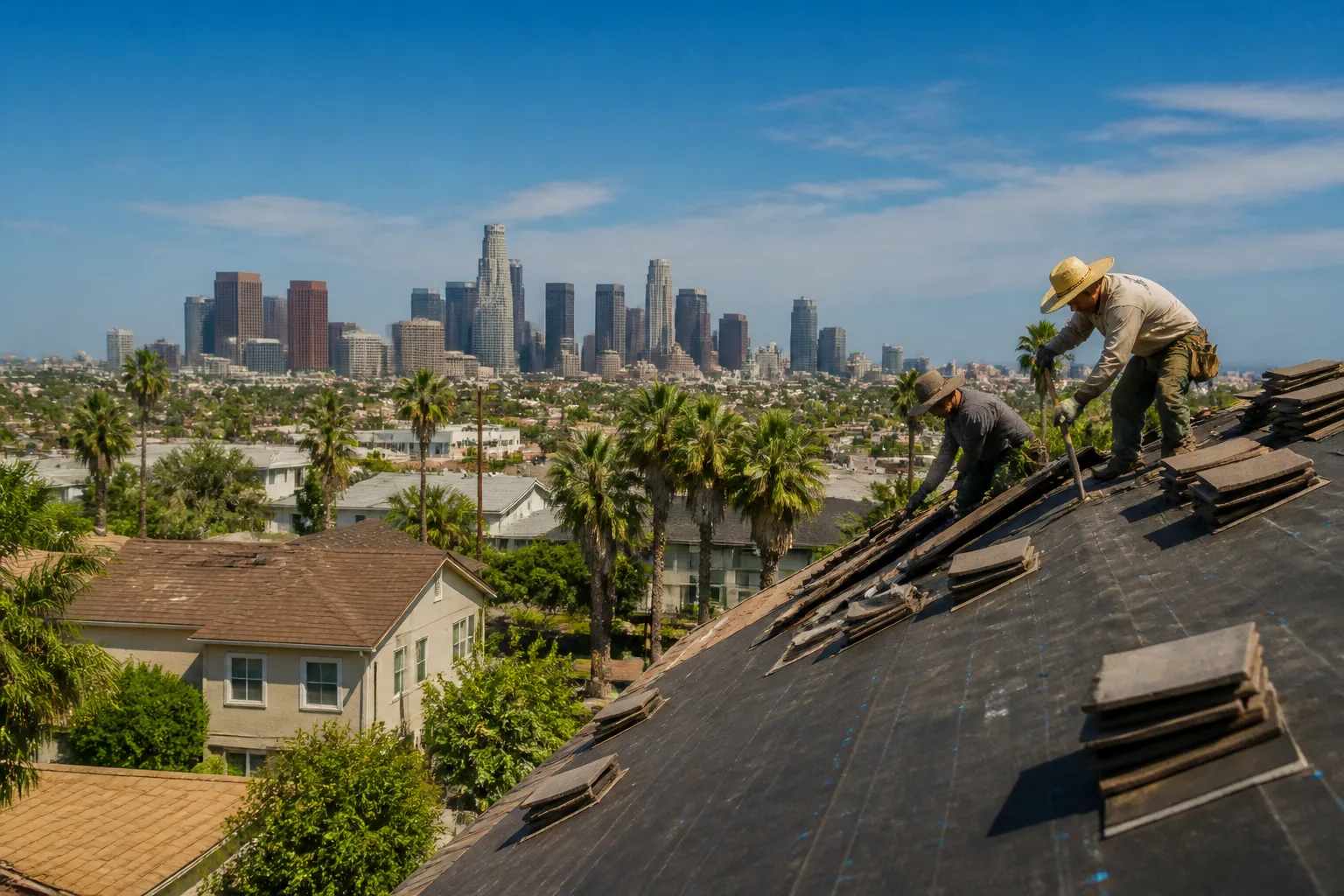
The contractor who signs your contract might be properly licensed, bonded, and insured. The crew that actually climbs your roof might be day laborers, unlicensed subcontractors, or a subcrew with no liability coverage of their own. If one of them gets hurt on your property, or if their work fails, you want to know whose insurance policy responds.
This matters more in Los Angeles than in some other markets because the roofing labor pool here is heavily subcontracted. A company with a good sales rep and a clean website might sub the entire job to a crew they’ve never met. We’ve pulled into driveways in Sherman Oaks where the homeowner had a contract with one company name but a truck parked out front with a different company’s name on the door.
Ask two direct questions before you sign:
- “Are your installers employees or subcontractors?” Both can work, but you have a right to know which one you’re getting.
- “If a subcontractor is on my roof and gets injured, whose workers’ comp covers it?” This is a one-call-to-their-insurance-agent question, and any contractor who bristles at it is giving you information.
At Tilehurst Roofing, background-checked, uniformed technicians work every job. You know exactly who’s on your roof, and they’re covered under the same liability policy that covers the company. When you call us, a live person answers 24/7. Not a voicemail box. Not a callback queue. A person. That matters when you need a Tilehurst Roofing home owner’s question answered on a Sunday evening and the rain is coming.
When to Call a Pro
You can prevent all five of these mistakes on your own with patience and a checklist. But there’s a moment when it’s smarter to bring in someone who does this every day. If you’re looking at a roof that’s over 20 years old, if you can see daylight in the attic, if you’ve got water stains on the ceiling after a heavy rain, or if a previous repair already failed once, you’re past the research phase. You need a written quote from someone who will actually do the work.
In Los Angeles, we handle roof repairs, full replacements, and everything between. We’ll give you the price in writing before any work starts, pull the permits, and hand you a written guarantee before the crew leaves. No change orders, no surprises at the door, no phone tag.
The Bottom Line
These five mistakes share a single root cause: homeowners trusting the process instead of verifying it. Check the permit. Get the quote in writing. Hold the deposit to the legal cap. Separate the manufacturer warranty from the workmanship warranty in your head and in your contract. And find out who’s actually doing the work before they climb the ladder. Do those five things and the shingle color almost picks itself.
If you’re in Los Angeles and want a written quote from a company that answers the phone and puts the guarantee in writing, call (945) 303-9821 for a free estimate. Greg Holloway and the team at Tilehurst Roofing will walk the roof with you, show you what we see, and hand you a written price before you decide anything.
Frequently Asked Questions
Most asphalt-shingle repairs in Los Angeles run between $400 and $1,200 depending on the scope. Small flashing fixes and minor shingle replacement sit at the lower end. Repairs involving decking, underlayment, or valley work run higher. The only way to know your real number is a written quote from someone who’s been on the roof. Call (945) 303-9821 and we’ll give you one free.
Not if the quote is written properly. A written quote with a fixed scope of work, a permit line item, and a change-order clause means the price only changes if you agree to additional work in writing. If a contractor won’t give you a written price before work starts, don’t start the work.
Full replacements require a permit in LA County. Structural repairs often do too. A simple shingle patch or small flashing repair may not. Ask your contractor to show you the permit before work begins, and make sure the permit cost is in the written estimate. If it’s not there, ask why.
Most standard asphalt-shingle replacements in Los Angeles take two to five days from tear-off to final inspection, depending on roof size, pitch, and weather. Larger or steeper roofs take longer. Your written quote should include a timeline, and the crew should stick to the window they gave you.
Written by Greg Holloway, Owner at Tilehurst Roofing, serving Los Angeles since 2000.
Need Roofing Help?
Call Tilehurst Roofing - licensed & insured, here with fast after-hours help in Los Angeles.
(945) 303-9821