
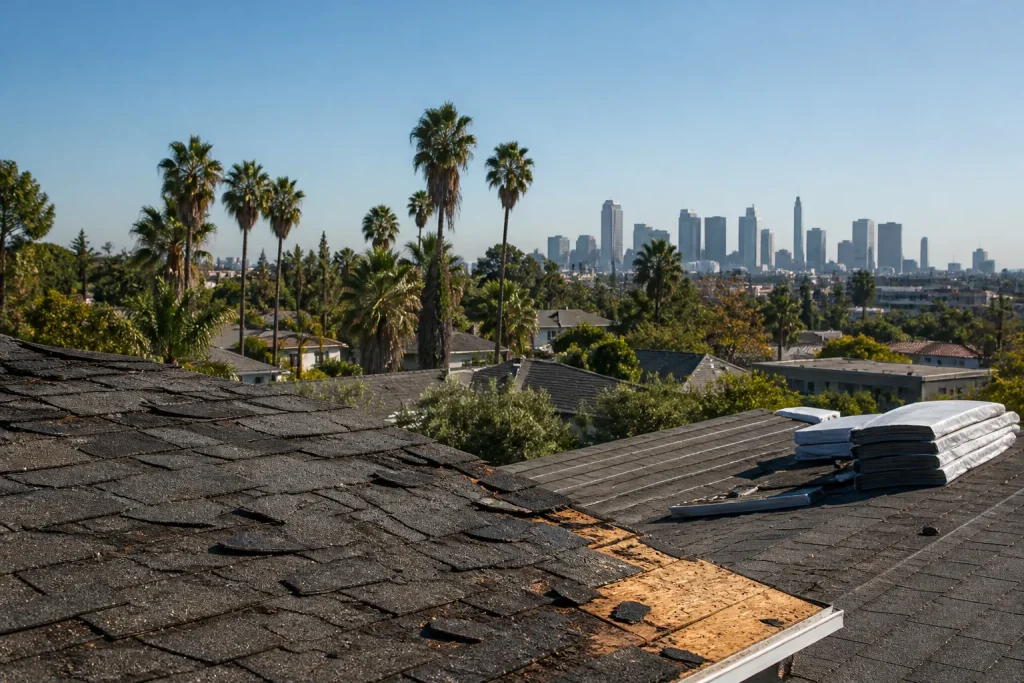
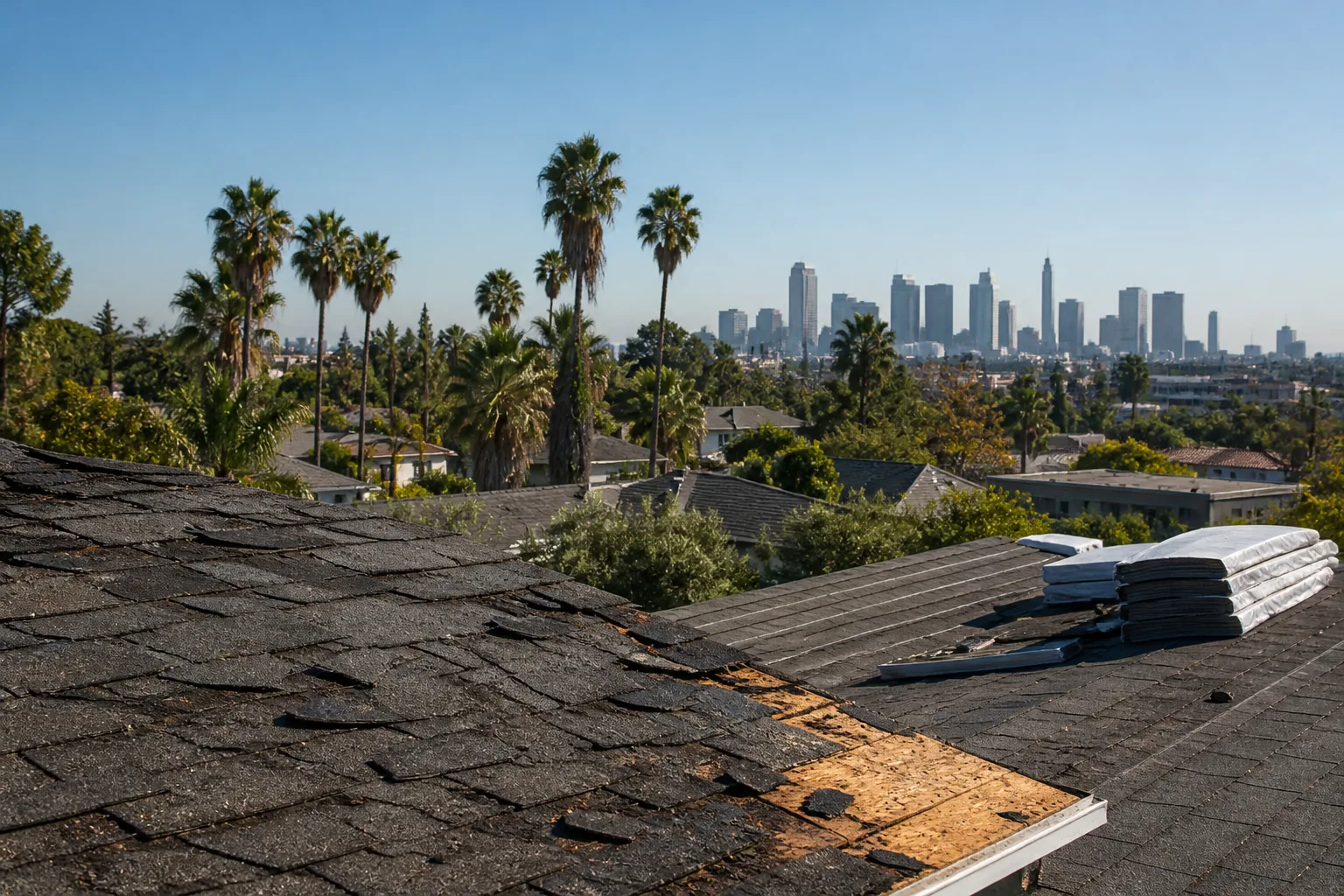
Roof Replacement: Repair or Replace? How Los Angeles Homeowners Decide
In Los Angeles, the repair-or-replace decision usually comes down to one question: is the failure isolated or systemic? A single leak around one pipe boot or one section of flashing is almost always repairable. Widespread granule loss, brittle decking, or leaks showing up in three different rooms means your roof has aged out, and patching it will just move money from one problem to the next. If you’d rather not sort through it alone, call Tilehurst Roofing at (945) 303-9821 and we’ll give you a straight answer.
A 12-year-old roof in Reseda and a 12-year-old roof in Portland have almost nothing in common by the time they hit that age. Los Angeles gets roughly 300 sunny days a year. That steady ultraviolet load breaks down asphalt shingle granules faster than most national roofing calculators predict. Add Santa Ana winds that lift and flex shingle edges, plus winter rain that arrives all at once instead of spread across months, and you get a degradation pattern that makes the standard “20-year shingle lifespan” rule nearly useless as a decision trigger here. The age of your roof tells you less than what your roof has actually been through.
Why Los Angeles Roofs Age Differently Than National Averages Say
The roofing industry quotes shingle lifespans based on national climate data. That data assumes a mix of seasons, moderate UV exposure, and rain distributed across the year. Los Angeles violates all three assumptions.
UV intensity is the big one. Asphalt shingles rely on granules to protect the asphalt underneath from direct sunlight. Those granules slowly dislodge over time, but in Los Angeles, the process accelerates. A roof in Atlanta might lose a meaningful percentage of granules by year 18. A roof in the San Fernando Valley can show the same granule loss by year 12. Once granules go, the asphalt bakes, the shingles turn brittle, and water intrusion becomes a question of when, not if.
Santa Ana winds add mechanical stress that granule loss alone doesn’t explain. Wind-driven rain pushes water sideways into ridge caps, pipe collars, and flashing joints that would otherwise stay dry. After enough Santa Ana seasons, those small failures become permanent pathways for water.
Concentrated winter rain compounds the problem. Los Angeles gets most of its annual rainfall in a handful of storms between December and February. A roof with small cracks or weakened seals might go nine months with zero issues, then suddenly leak during a single week of heavy rain. That pattern fools homeowners into thinking the roof is fine, because it is fine, right up until the one storm that says otherwise.
We’ve pulled shingles off 10-year-old Los Angeles roofs that looked more like 20-year-old roofs anywhere else. If your contractor is quoting national averages, they’re not quoting your roof.
Isolated Failure vs. Systemic Failure: The Only Decision That Matters
Strip away the jargon and the repair-or-replace decision is binary. You’re looking at either an isolated failure or a systemic failure.
Isolated failure means one specific component failed while the rest of the roof remains sound. Examples include:
- A single pipe boot cracked from UV exposure
- One section of flashing pulled loose at a chimney
- A small puncture from a fallen branch
- One valley leaking while the surrounding shingles still have granule coverage
Isolated failures are repairable, and a good repair will hold for years. The key phrase is “the rest of the roof remains sound.” That’s what a written assessment should confirm, and we’ll get to what that assessment needs to include.
Systemic failure means the roof as a whole has reached the end of its useful life. Signs include:
- Granule loss across the majority of the roof surface, not just one slope
- Shingles that crack when you bend them, or curl at the corners
- Leaks in multiple rooms with no single obvious cause
- Decking that feels soft or spongy when walked on
- Multiple prior repairs that each held for a year or less
We worked on a home in Silver Lake where the owner had patched three separate leaks over two years. Each patch held, but the leaks kept moving. When we pulled a section of decking, the plywood had delaminated across half the roof. The three leaks weren’t three problems. They were three symptoms of one problem. That roof needed replacement, and every repair before it had only been buying months, not years.
If you’re seeing repeated failures in different locations, that’s your answer. The roof is telling you it’s done.
Why a Passing Inspection Isn’t the Same as a Holding Repair
Los Angeles requires permits for roof replacement and most reroofing work. Those permits come with inspections. The inspector’s job is to verify code compliance: proper underlayment, correct nail patterns, adequate ventilation, and so on. That’s an important function, but it’s not the same as verifying durability.
A repair can pass inspection and still fail within months. Here’s why: the inspector checks for code minimums at the moment of installation. The inspector does not evaluate whether the repair addresses the actual failure mode. A roofer can re-nail a loose flashing, pass the inspection, and leave behind the same drainage problem that pulled the flashing loose in the first place. Six months later, the flashing is loose again, and the homeowner has a passed inspection from a repair that didn’t hold.
This is why we tell Los Angeles homeowners to ask different questions of different people:
- Ask the inspector: “Does this meet current code? Is the ventilation adequate? Is the installation correct per manufacturer guidelines?”
- Ask the contractor: “What caused this failure, and how does this repair prevent the same failure from recurring? What exactly does your written guarantee cover, and for how long?”
A contractor who can’t explain the cause of the failure is guessing. And a contractor who guesses doesn’t deserve to be on your roof. At Tilehurst, every repair is covered by a written guarantee before the crew leaves your property, and if the repair fails inside the guarantee period, we return to correct it at no charge under the 365-Day Done Right Promise. If it’s not done right, we make it right, for a full year after the job.
Most asphalt shingle repairs in Los Angeles run $350 to $900 depending on the component and access. A full replacement typically runs $9,000 to $18,000 for a standard single-family home using architectural shingles. When the repair quote starts approaching 15 to 20 percent of the replacement cost, and the roof shows other signs of age, replacement is usually the smarter money.
If you’re looking for a roof repair in Los Angeles, get the written price before the work starts. If a contractor won’t put the price and the guarantee on paper before touching your roof, call someone else.
How Home Sale Timing Changes the Math
Planning to sell in the next two to three years? The repair-or-replace calculation shifts, but not in the direction most people assume.
A roof with obvious issues will come up during the buyer’s home inspection. At that point, you’re not negotiating on your terms. You’re negotiating during escrow, when you have the least leverage and the buyer has the most. A buyer’s inspector flags granule loss, curling shingles, or a stain on the underside of the decking, and suddenly that $700 repair you deferred becomes a $12,000 credit demand, because the buyer’s agent knows a new roof is coming eventually anyway.
Here’s the framework we walk sellers through:
- Isolated failure, selling within a year: Repair it now, get the written guarantee, and disclose the work during escrow. A documented repair with a transferable record is far more valuable than an undiagnosed stain.
- Systemic failure, selling within three years: Replace the roof before listing. You’ll pay retail now instead of negotiating a credit later, and you’ll avoid the buyer’s lender flagging the roof condition and delaying or killing the deal entirely.
- Systemic failure, selling later than three years: You have time, but don’t gamble. Roof costs in Los Angeles have risen significantly since 2020, and labor and material inflation isn’t slowing. Deferring replacement means betting the price of shingles goes down. Historically, that’s a losing bet.
Any roofing company in Los Angeles should be able to give you a written assessment that separates isolated issues from systemic wear. That document is what you’ll show the buyer, the buyer’s agent, and the appraiser if questions come up.
What a Written Contractor Assessment Must Include Before You Decide
The single most valuable document you can get before making a repair-or-replace decision is a written condition assessment. Not a quote. An assessment. The difference matters.
Here’s what a real written assessment should include:
- Age estimate and material type: What’s on the roof now, how old it appears to be, and whether the original installation used quality materials.
- Granule loss evaluation: Where granule loss is concentrated, how severe it is, and whether the underlying asphalt is exposing.
- Decking inspection notes: Whether roof decking shows signs of moisture damage, delamination, or soft spots, and where those spots are.
- Flashing and penetration status: The condition of flashing at chimneys, valleys, vents, pipe collars, and skylights, with photos.
- Ventilation check: Whether attic ventilation is adequate, because poor ventilation shortens roof life regardless of material quality.
- Repair vs. replace recommendation with reasoning: Not just a preference, but the logic behind it. “We recommend replacement because granule loss covers 60% of the roof and decking shows moisture staining in two sections.”
- Line-item repair cost or full replacement cost: In writing, itemized, before any work begins.
A quote that skips the written assessment is itself a red flag. If a contractor gives you a number without walking the roof and documenting what they found, they’re pricing a guess. You’re about to spend real money on a guess.
We follow what we call The Kingswell Way on every job: say the price before the work, show up in the window we gave, leave the place cleaner than we found it, put the guarantee in writing, and come back if it fails. The written assessment is where it starts. You can’t make a repair-or-replace decision without knowing what’s actually happening up there.
Materials Matter: What Los Angeles Heat and Wind Actually Demand
Not every shingle performs equally under Los Angeles conditions. The right material for a home in the Valley isn’t automatically the right material for a home in Pacific Palisades, and UV exposure, wind exposure, and slope all factor into the choice.
We install from seven leading manufacturers: GAF, CertainTeed, Owens Corning, IKO, Atlas, Tamko, and Boral. That’s not because we want a warehouse full of options. It’s because the product should fit the home, not just what happens to be on the truck that day.
For most Los Angeles homes, architectural asphalt shingles from Owens Corning or Atlas offer the best balance of cost, warranty, and UV performance. Homeowners in high-wind corridors near the foothills often choose IKO or Tamko products with higher wind ratings. For those who want a heavier, longer-lived roof and own a home that can handle the extra weight, Boral’s stone-coated steel and tile profiles hold up under UV better than nearly anything else on the market, and they carry a visual weight that fits traditional Los Angeles architecture well.
Whatever you choose, the material is only as good as the installation. A premium shingle nailed to damaged decking or installed over failed underlayment will fail early. That’s the reason we don’t let the material conversation happen before the assessment conversation. You need to know what condition the roof is in before you decide what goes on top of it.
See our full roof replacement in Los Angeles page for a breakdown of material options, timelines, and what a full replacement actually involves.
When to Call a Pro
If you see daylight through the attic boards, water stains spreading across a ceiling, or granules collecting in your gutters every time it rains, don’t wait. Granules in the gutter are not cosmetic. They’re the roof losing its protective layer, and every week of Los Angeles sun after that accelerates the underlying damage.
Roof work involves heights, and in some cases electricity, gas lines, or compromised decking. Falls and decking collapse are the two most common serious injuries on roofing jobs. If you’re not experienced on a roof, stay off it. Call a licensed professional, get the written assessment, and make a decision with real information instead of a ladder and a hope.
If you need help, we’re a roofing company in Los Angeles and we’re glad to take a look. A live person answers every call, 24 hours a day, 7 days a week. No voicemail, no callback queue, no waiting until Monday.
The Bottom Line
The repair-or-replace decision in Los Angeles hinges on one thing: whether your roof’s problem is isolated or systemic. UV exposure, Santa Ana winds, and concentrated winter rain age Los Angeles roofs faster than national averages predict. If one component failed, repair it. If the failure is showing up in multiple places, the decking is compromised, or the granules are gone across most of the surface, replacement is the honest choice, and delaying it usually just makes the eventual replacement more expensive.
Get a written assessment before you decide. Ask the contractor to explain the cause of the failure, not just the fix. Get the price in writing before any work starts. And if a repair is the answer, make sure it comes with a written guarantee, not a promise.
If you’re in Los Angeles and want a straight answer about your roof, Tilehurst Roofing offers free estimates. Call (945) 303-9821 and we’ll walk the roof, document what we find, and put our recommendation in writing.
Frequently Asked Questions
Most standard asphalt shingle roof replacements in Los Angeles run between $9,000 and $18,000 for a typical single-family home. The price varies with roof size, slope, number of stories, and material choice. Tile and stone-coated steel options run higher. Call (945) 303-9821 for an exact quote. Estimates are free.
Look for signs of systemic failure: granule loss across most of the roof, leaks in multiple rooms, shingles that crack when bent, or decking that feels soft. If issues are confined to one flashing, one pipe boot, or one valley, a repair is likely sufficient. A written roof assessment from a contractor you trust will give you a definitive answer.
Not necessarily. Inspection confirms code compliance at the time of installation. It does not verify that the repair addressed the root cause of the failure. Ask your contractor to explain what caused the failure and how the repair prevents recurrence, and make sure the repair includes a written guarantee. Every Tilehurst repair carries a written guarantee, and if it fails inside the guarantee period, we return at no charge.
Most single-family roof replacements take one to three days for tear-off, decking repair, underlayment, and shingle installation. More complex roofs, tile roofs, or steep slopes can take longer. The permitting process with the City of Los Angeles can add time before the job begins, so plan for that when you schedule. Call (945) 303-9821 and we’ll give you a realistic timeline for your roof.
Written by Greg Holloway, Owner at Tilehurst Roofing, serving Los Angeles since 2000.
Need Roofing Help?
Call Tilehurst Roofing - licensed & insured, here with fast after-hours help in Los Angeles.
(945) 303-9821