
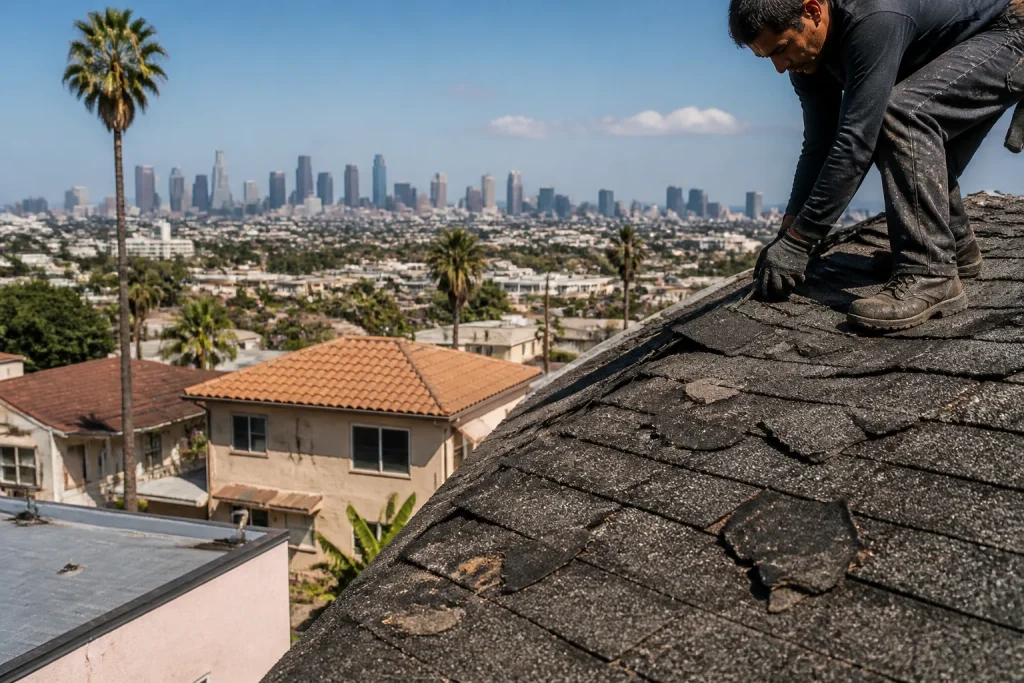
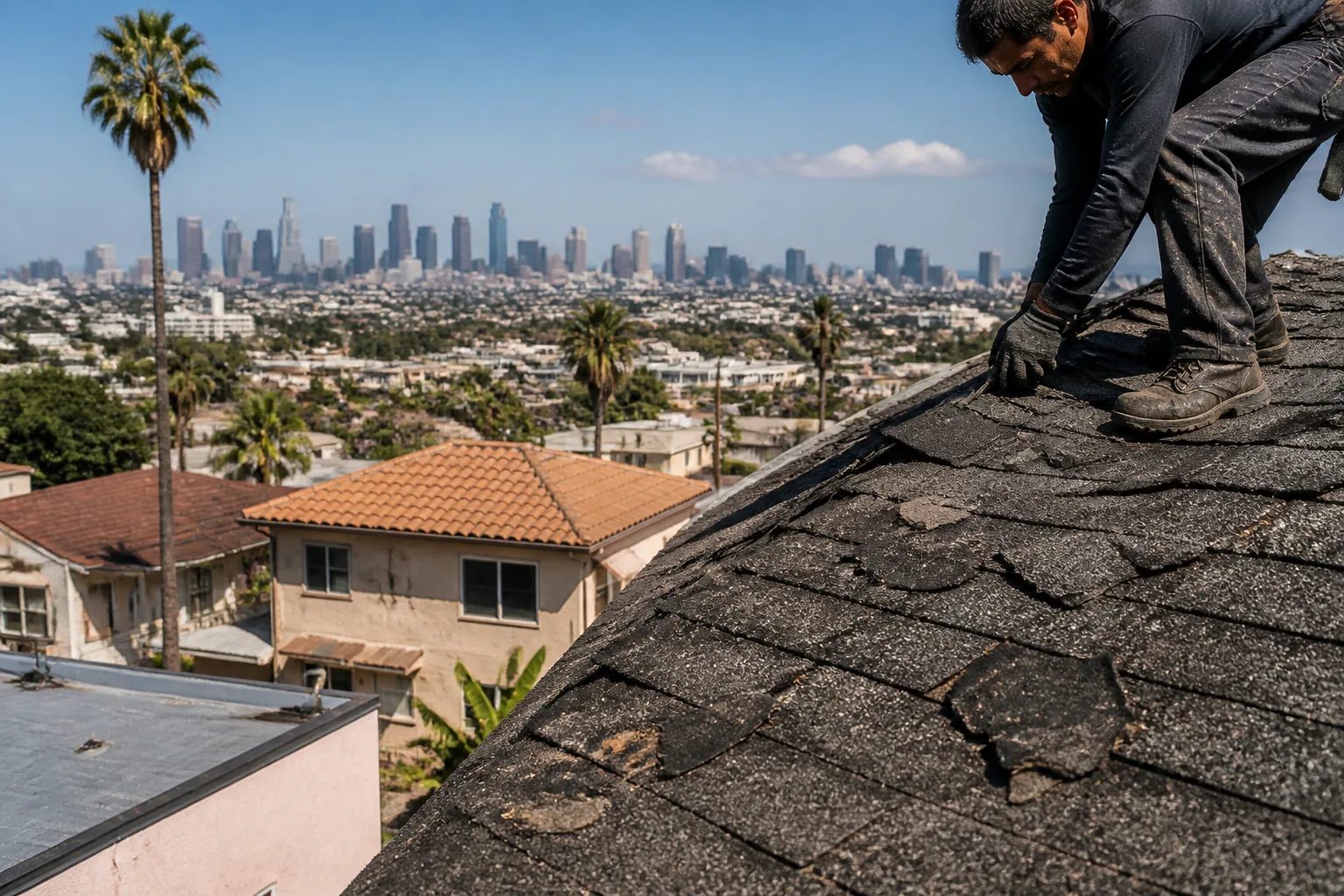
5 Mistakes to Avoid With Roof Repair
Most roof repair failures don’t start with bad shingles. They start with a decision made under pressure, usually within 48 hours of discovering a leak, before anyone has actually looked at the roof. The repair that falls apart in six months almost always shares one trait: the homeowner approved it the same day they saw the water stain. If you’d rather skip the guesswork and have a roofer look at it properly, call (945) 303-9821 for a free estimate.
We’ve been part of the Kingswell family of roofing companies since 2000, and we’ve watched the same five mistakes repeat themselves across Los Angeles, from Sherman Oaks to Silver Lake. Here’s what they are, and how to avoid them.
1. Approving a Spot Repair Without a Written Cause of Failure
This is the big one. A leak shows up on your ceiling, you call a roofer, they slap a patch over the visible problem area, and three months later the stain is back. The mistake wasn’t the patch. The mistake was that nobody wrote down why the leak happened in the first place.
Think about it this way. Water that appears near your living room window may have entered the roof twenty feet away, traveled along a rafter, and dripped down at the first convenient gap. A spot repair fixes the drip, not the entry point. In Los Angeles, where roofs bake under months of sun before getting hit with sudden winter rain, thermal expansion and contraction open small gaps at flashing points that a quick patch never addresses.
Before you approve any repair over $500, ask the contractor to document in writing what caused the leak, not just where it showed up inside. That means identifying the specific failure: cracked pipe boot, failed step flashing, torn underlayment, worn ridge cap, or compromised decking around a penetration. If they can’t tell you the cause, they can’t guarantee the fix. We put this in writing on every job. The Kingswell Way is simple: say the price before the work, show up in the window we gave, put the guarantee in writing, and come back if it fails. A contractor who won’t write down the cause of failure is telling you something important before you’ve spent a dollar.
2. Choosing a Contractor Based on Same-Day Availability Alone
When water is coming through the ceiling, the instinct is to grab the first roofer who can show up today. That’s understandable. It’s also how a lot of Los Angeles homeowners end up with rushed repairs.
Here’s what we’ve learned in 25 years of doing this: a roofing company that can always be at your house the same day is often a company turning jobs fast, not necessarily doing them right. Good roofers are busy because word travels. The crew that has an open schedule on a rainy Tuesday in February might be available for a reason. Now, that doesn’t mean you should wait a week with a tarp flapping on your roof. It means the question to ask isn’t “When can you get here?” It’s “When you get here, what will you actually check?”
If there’s an active leak, any reputable roofer in Los Angeles can guide you through a temporary tarp or patch to stop the bleeding while scheduling a proper repair. We’ve done this countless times. Stop the water, document the damage, then plan the fix with a clear head. A two-day delay for the right diagnosis beats a same-day patch that buys you until the next rainstorm.
3. Skipping the Second Opinion on Repairs Over $800
Nobody enjoys making a contractor explain things twice. It feels awkward, almost like you’re accusing them of something. But here’s the truth from inside the trade: reputable roofers expect second opinions on bigger repairs, and we welcome them. If a contractor gets defensive when you mention getting another estimate, that’s a signal worth paying attention to.
Let’s put real numbers on this. In Los Angeles, a minor flashing repair might run $350 to $700 depending on accessibility, roof pitch, and the material involved. A more involved repair, like replacing a section of decking along with underlayment and shingles, often lands between $900 and $2,200. Once you cross that $800 threshold, a second set of eyes can catch things like a roofer scoping the job too narrowly to keep their number low, or recommending a full replacement when a targeted repair would do.
What should the second contractor check? The same things the first one should: attic ventilation, decking condition, flashing at every penetration and transition, pipe boots, ridge caps, and the age and condition of the underlayment. Ask both contractors the same set of questions, and compare their answers side by side. You’re not looking for the lower number. You’re looking for the roofer who can explain the problem clearly and put the fix in writing. The Roof Repair in Los Angeles process we follow includes exactly this kind of documentation, so homeowners can compare apples to apples.
4. Letting the Insurance Adjuster’s Scope Drive the Repair Plan
Insurance adjusters have a job to do, and that job is to settle claims efficiently for the insurer. They’re not bad people. But the scope of work they write up is a starting point, not a construction plan. In Los Angeles, where many homes have older roofs with multiple layers or code-related requirements triggered by repair size, the adjuster’s scope frequently misses items that matter.
We see this constantly. An adjuster writes up replacing ten shingles and a section of underlayment. What they didn’t see is the rotted decking underneath, or the fact that the existing underlayment doesn’t meet current Los Angeles building code, or that the repair triggers a requirement to bring adjacent fire-resistance detailing up to standard. When the contractor simply works from the adjuster’s scope without independently reviewing the roof, those gaps become the homeowner’s problem later, either as out-of-pocket change orders or as repairs that fail down the line.
The fix is straightforward. Have a qualified roofing contractor walk the roof with the adjuster’s scope in hand and prepare an independent assessment. If there’s a gap, the contractor can document it and help you go back to the insurer. You don’t have to fight a claim alone. You just need someone on the roof who works for you, not for the insurance company. At Tilehurst, we prepare our own scope on every insurance-related repair, because the roof doesn’t care what the paperwork says.
5. Not Asking How Long the Warranty Lasts and Whether It Covers Labor
This one quietly costs Los Angeles homeowners thousands every year. The roofer says “Don’t worry, it’s guaranteed.” Three months later, the repair fails, and the homeowner discovers the guarantee covered materials only. The labor to tear off the failed patch and redo the work? That’s on them.
Manufacturer warranties typically cover shingle defects for a certain number of years, but they often cover materials only and may be prorated. Labor, the part that actually costs money on a repair, is covered by the contractor’s workmanship warranty, and that’s only as good as the paper it’s written on. A verbal “we’ll take care of it” evaporates the moment the truck leaves the driveway.
Here’s what to ask before you sign anything: How long is the labor warranty, in months or years? Is it in writing? Does it cover the full cost of redoing the repair if the same issue returns, or just a discounted rate? Who do I call, and will a live person answer? These questions feel demanding, but any contractor who’s proud of their work will answer them without hesitation. We hand every customer a written guarantee on every repair before the crew leaves. If a repair fails inside the guarantee period, we return at no charge under the 365-Day Done Right Promise, a full year of documented accountability. No fine print, no phone tag. That’s the standard to look for.
What These Mistakes Have in Common
Notice the pattern. Every mistake on this list happens before a hammer touches a shingle. They’re decision-making errors made under pressure: approving a patch without understanding the cause, hiring for speed, skipping the second opinion, deferring to the adjuster’s scope, and trusting a verbal warranty.
The physical work of roof repair is the easy part, honestly. Diagnosing the failure correctly, scoping the fix completely, and documenting the guarantee properly, that’s where roofs get saved or lost. In a market like Los Angeles, where buildings range from 1920s Spanish Revival in West Adams to mid-century ranches in the Valley, the right repair approach varies wildly by roof type, material, and age. A roofer who treats every roof the same is a roofer who will eventually miss something important.
When to Call a Pro
If you answer yes to any of these, pick up the phone: water staining on any ceiling or wall, granules collecting in your gutters, shingles in the yard after a wind event, daylight visible through the attic boards, or a roof older than 15 years that hasn’t been professionally inspected in the last five. Roof work on a pitched roof carries real fall risk, and walking on roofing materials incorrectly can do more damage than the original problem. This is one part of home maintenance where the trained professional with proper safety equipment is not a luxury.
For homeowners in Los Angeles, we offer free estimates on all roof repairs, from small flashing fixes to full replacement. Our crews are background-checked and uniformed, and we carry material options from seven leading manufacturers; on most repair jobs, choices from CertainTeed, Owens Corning, IKO, and Atlas give you genuine control over what goes back on your roof, not just whatever happens to be in the truck.
Related Services in Los Angeles
If this post has you thinking about larger roof questions, our Roofing Company in Los Angeles page walks through the full range of what we do, from repair to complete re-roofing, and the Roof Replacement in Los Angeles guide covers what a full tear-off actually costs and involves. For the broader picture of who we are and how we work, start at the Tilehurst Roofing home page.
What happens when you call
- 1
A real person answersNo phone trees - you reach a local pro.
- 2
You get an upfront price rangeHonest numbers before anyone is dispatched.
- 3
A background-checked tech heads outLicensed & insured, dispatched right away.
- 4
You approve before work beginsNothing starts until you say go.
The Bottom Line
Roof repair mistakes are almost always made in the 48 hours after a leak appears, not on the roof itself. Slow down the decision just enough to get the cause of failure in writing, get a second opinion on repairs over $800, review the insurance scope independently, and insist on a written labor warranty with a real duration. Ask these questions on the front end and you’ll never be the homeowner praying through the next rainstorm. If you’re in Los Angeles and need help, Tilehurst Roofing offers free estimates, call (945) 303-9821.
Frequently Asked Questions
Most minor roof repairs in Los Angeles run between $350 and $700, while larger repairs involving decking replacement, underlayment, and shingles typically range from $900 to $2,200. Flat roof work, specialized materials, and steep-pitch access can push costs beyond that range. Call (945) 303-9821 for a written, line-item estimate on your specific repair.
A credible roof repair warranty should cover labor for at least one year in writing, separate from any manufacturer material warranty. Ask for the labor coverage in writing before work starts, not after. If a contractor can’t or won’t commit to a written labor warranty, keep looking.
Small tasks like cleaning gutters are manageable for many homeowners, but actual repair work on a pitched roof requires fall protection, correct material knowledge, and an understanding of how water moves through a roof system. The risk of injury and the chance of making the leak worse both rise quickly without training. For anything beyond a visual inspection from a ladder, we recommend a licensed professional.
A temporary tarp or emergency patch can often be deployed within a day to stop active water intrusion. A proper, documented repair with a written cause of failure and warranty may take a few days to schedule, especially during Los Angeles’s rainy season when reputable roofers are in high demand. The right question is not “how fast?” but “what will you actually check and what will you put in writing?”
Written by Greg Holloway, Owner at Tilehurst Roofing, serving Los Angeles since 2000.
Need Roofing Help?
Call Tilehurst Roofing - licensed & insured, here with fast after-hours help in Los Angeles.
(945) 303-9821