
5 Mistakes to Avoid With Roof Replacement
A roof replacement in Los Angeles is a five-figure decision most homeowners make once, with no trial run to fall back on. The costliest mistakes aren’t picking the wrong shingle color or chasing the cheapest bid. They’re contract gaps and staging decisions that seem minor during the handshake but turn into surprise invoices, permit delays, and warranty dead ends once the tear-off begins. Here are the five mistakes we see cost homeowners real money every year, and how to avoid them.
If you’d rather skip the reading and talk through your specific roof, call (945) 303-9821 for a free estimate.
1. Signing a Contract With Undefined Allowances
The most expensive line in a roof replacement isn’t the shingle or the labor. It’s the change order you didn’t see coming because the contract baked in language like “decking replacement as needed” or “flashing TBD” without requiring a cap in writing before work begins.
What that phrase means in plain English: the price you agreed to covers the roofing materials, but the wood underneath is an open question. Once tear-off starts and the crew finds water-damaged decking, you’ll pay per sheet to replace it. The same goes for flashing around chimneys and skylights. If the contract doesn’t specify how much decking replacement is assumed, or what the per-sheet charge is beyond that assumption, the number on your final invoice is no longer something you control.
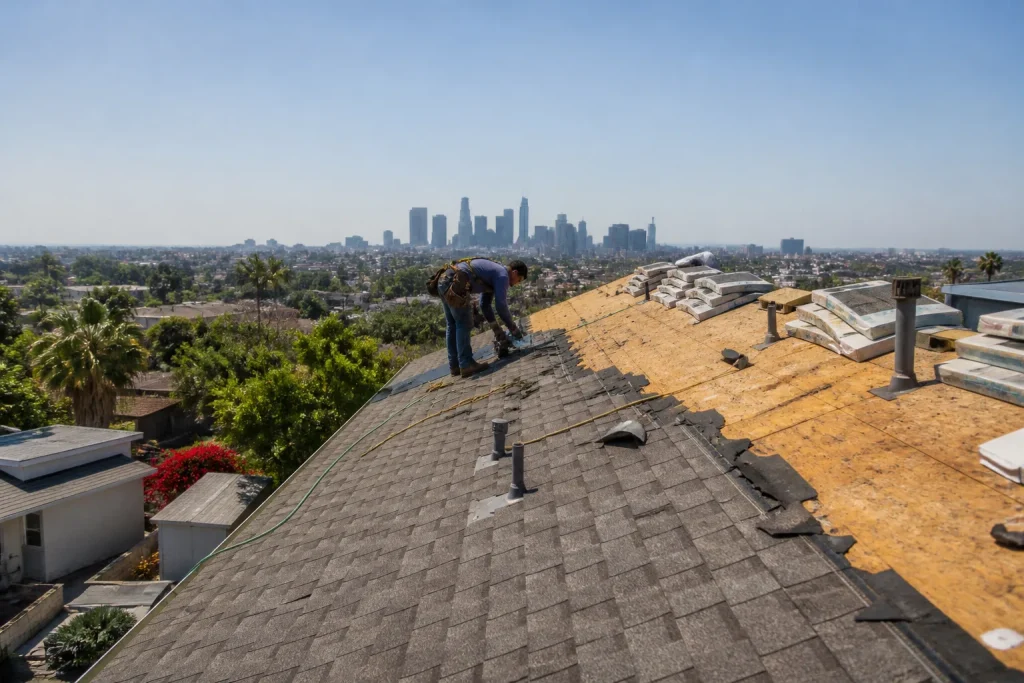
One job we did over in Sherman Oaks had three layers of old shingles hiding decking so far gone the homeowner thought he was buying a straightforward replacement. The contract from the other company said “decking as needed.” No cap, no per-sheet price, no photos of the problem. That is a blank check written in roofing language.
What to do instead: require a written allowance. The contract should state how many sheets of decking are included, what each additional sheet costs, and that any charge beyond the allowance requires your approval before work continues. At Tilehurst Roofing, written price before any work starts means exactly that. The price on paper is the price you pay, and any allowance is spelled out with a number, not a phrase.
2. Skipping Permit Timing in Your Project Schedule
Los Angeles is different from most cities. The Los Angeles Department of Building and Safety (LADBS) manages permits, and the timeline for a roof replacement permit depends on the district office, current staffing, and the complexity of the project. If the permit is not pulled before the tear-off date, the crew might be standing in your driveway with a tarp and a wait, because the city has not cleared the work to begin.
That is not a contractor excuse. It is the reality of building in a city where everything runs through LADBS plan check, and where simple over-the-counter permits for roof replacements can take anywhere from a day to a week depending on the office volume. A full replacement on a home in a Historic Preservation Overlay Zone takes even longer, because the design has to clear additional review.
What to check before you sign:
- Does the contract include permit costs as a line item, or are they listed as TBD?
- Who is responsible for pulling the permit and scheduling inspections?
- Has anyone confirmed the current LADBS timeline for your specific property type?
A contractor who says permits are “no big deal” is not the one who will be standing in your living room explaining why the crew is three days late. Ask for the permit timeline in writing, or at minimum a date by which the permit will be applied for. It protects your schedule as much as your roof.
3. Choosing the Lowest Bid Without Comparing Line Items
Roof replacement bids in Los Angeles are not apples to apples, even when both quotes list “architectural shingles.” The differences live in the line items that disappear from low bids, not from the job itself.
Underlayment grade is the first one to vanish. A synthetic underlayment costs more than felt and performs better, especially during the wet months. If the low bid doesn’t specify the underlayment, assume the cheapest available. Valley treatment is another. Woven valleys are more labor, but they handle Los Angeles rain better than an open valley with exposed metal. Ridge ventilation, if your attic needs it, can change the lifespan of your new roof by years. And debris disposal, the dumpster and haul-away line that seems trivial until the crew leaves a mountain of old shingles at your curb.
When you compare bids side by side, line them up:
- What underlayment is specified?
- How are the valleys being treated?
- Is ridge ventilation included or extra?
- Who pays for debris disposal, and what does that include?
We carry materials from seven manufacturers because the product should fit the home, not whatever happens to be in the truck. That means Owens Corning for some homes, IKO for others, Atlas for some, Tamko for others, plus GAF, CertainTeed, and Boral. The low bid often can’t tell you the difference because it is only buying one thing: the price.
When comparing roof replacement costs, insist on a written price that includes every line item. A quote that arrives on a napkin with “shingles + labor” written in pencil is not a quote. It’s a starting point for negotiations you didn’t know you were entering.
4. Paying Too Much Before Materials Arrive
California law limits the down payment a contractor can take for home improvement work, but what is legal and what is smart are not always the same conversation. Paying a large upfront chunk tied to a calendar date, rather than a project milestone, puts you in a weak position if the project slips, the materials are backordered, or the company goes quiet.
A payment schedule should track the work, not the contractor’s cash flow. That means the first payment covers materials or permit costs, not the entire profit on the job. The next payment should be tied to a visible milestone: tear-off complete, underlayment and flashing installed, shingles done, final inspection passed. When the payment schedule says “50% due on day seven” and the roof is still in tear-off on day seven, the schedule is protecting the wrong party.
What to ask before you sign:
- What percentage is due at contract signing?
- What specific milestone triggers each subsequent payment?
- Is the final payment held until the LADBS inspection passes and you have the warranty registration number in hand?
At Tilehurst Roofing, part of the Kingswell Way is saying the price before the work and tying payments to the work itself. No surprise invoice at the end, no escalation at the door. When Greg Holloway walks you through a contract, the numbers match the milestones, not the calendar.
5. Skipping the Final Walkthrough and Warranty Registration
The roof is finished. The crew is packing ladders. This is the moment most homeowners miss, and it costs more than any shingle upgrade.
Two things have to happen before the truck pulls away. First, the post-installation walkthrough. You walk the roof with the project lead, inspect the ridge cap, the flashing around chimneys and vents, the drip edge at the eaves, and the valleys. You confirm the debris is gone, the gutters are clear, the ground is clean. The Kingswell Way says leave the place cleaner than we found it, and that is not a preference. It is a checkable promise, and the walkthrough is where you check it.
Second, the manufacturer warranty registration number. Shingle manufacturers like IKO, Atlas, and Tamko issue warranty coverage that often requires registration within a specific window after installation. If the contractor holds the registration and never files it, or files it with a typo in your address, your 30-year shingle warranty is a piece of paper that means nothing. Get the registration number in writing before the final payment.
Both of these are leverage you lose the moment the truck pulls away. The roof is not done until the paperwork is in your hand.
When to Call a Pro
If any of this makes you want to re-read a contract you signed last year, or if you are staring at a bid right now with a phrase you don’t recognize, call a professional before you sign. A roof replacement in Los Angeles is not a weekend project. It is structural work on the thing that keeps weather out of your home. When the stakes are a five-figure investment, the safest move is a second set of experienced eyes.
Related services: Roof Replacement in Los Angeles and Roof Repair in Los Angeles. We’re also part of the Roofing Company in Los Angeles network under the Kingswell family of companies.
The Bottom Line
The five mistakes are connected by one theme: the details you don’t define in writing are the details you pay for later. Undefined allowances become change orders. Unclear permit timelines become delays. Low bids become missing line items. Payment schedules tied to dates become leverage problems. And skipping the final walkthrough means losing warranty protection the day the job ends. A roof replacement in Los Angeles deserves a contract that reads like a complete sentence, not a suggestion.
If you are planning a roof replacement and want a written price that covers every line item, a permit timeline that is confirmed before tear-off, and a warranty registration number in your hand before final payment, Tilehurst Roofing offers free estimates. Call (945) 303-9821 and talk to a live person, 24 hours a day, seven days a week.
Frequently Asked Questions
The most common mistake is signing a contract with undefined allowances, like “decking replacement as needed,” without a written cap or per-sheet price. That phrase turns into change orders once tear-off reveals water damage. In Los Angeles, where older homes often hide multiple layers of shingles and damaged decking, an undefined allowance can add thousands to the final invoice. Ask for a written allowance with a per-sheet price and a cap before work begins. For an exact quote, call (945) 303-9821.
Roof replacement permits in Los Angeles typically take one to seven days through LADBS, depending on the district office and whether the property is in a Historic Preservation Overlay Zone. Standard asphalt shingle replacements are often over-the-counter permits, but older homes or specialty materials can extend the review. Confirm the permit timeline with your contractor in writing before scheduling tear-off. The crew should not arrive until the permit is pulled.
Under California law, the down payment for home improvement work is capped, but the smarter move is tying every payment to a specific milestone rather than a calendar date. The first payment should cover materials and permits, not the entire profit margin. The final payment should be held until the LADBS inspection passes and the warranty registration number is in your hand. If a contract says 50% due on day seven regardless of progress, negotiate the schedule.
Yes, most manufacturer warranties from shingle brands like IKO, Atlas, and Tamko require registration within a specific window after installation. If the contractor never files the registration, or files it incorrectly, the warranty is not valid. Get the registration number in writing before the crew leaves the site and before you make the final payment. At Tilehurst Roofing, written guarantee on every repair and warranty registration confirmation are part of the job, not an add-on. Call (945) 303-9821 to talk through the details – estimates are free.
Written by Greg Holloway, Owner at Tilehurst Roofing, serving Los Angeles since 2000.
Need Roofing Help?
Call Tilehurst Roofing - licensed & insured, here with fast after-hours help in Los Angeles.
(945) 303-9821