
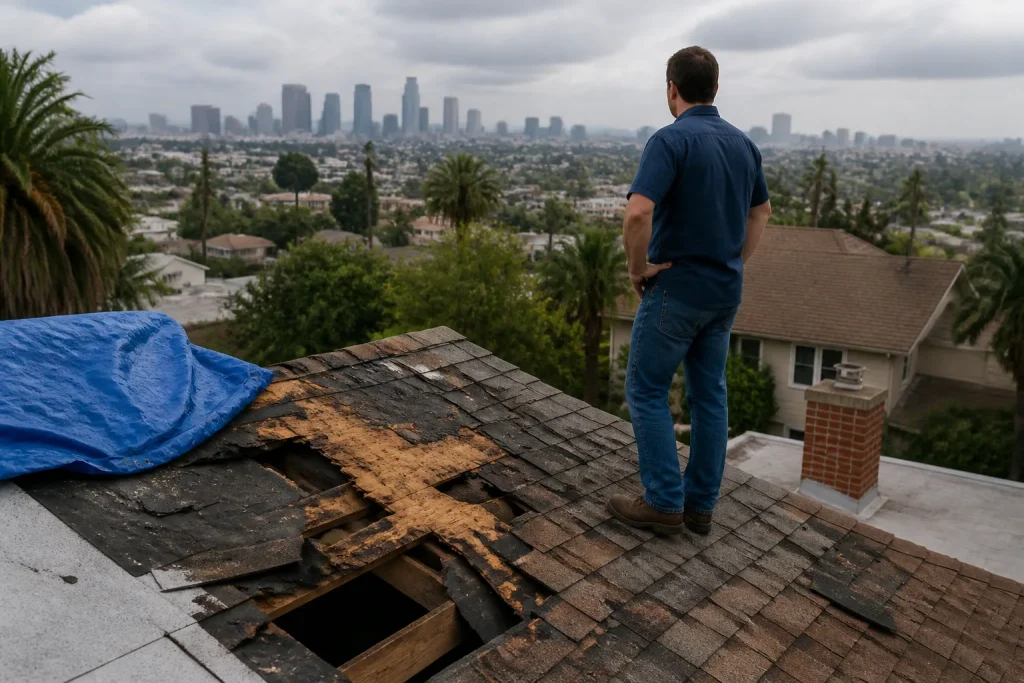
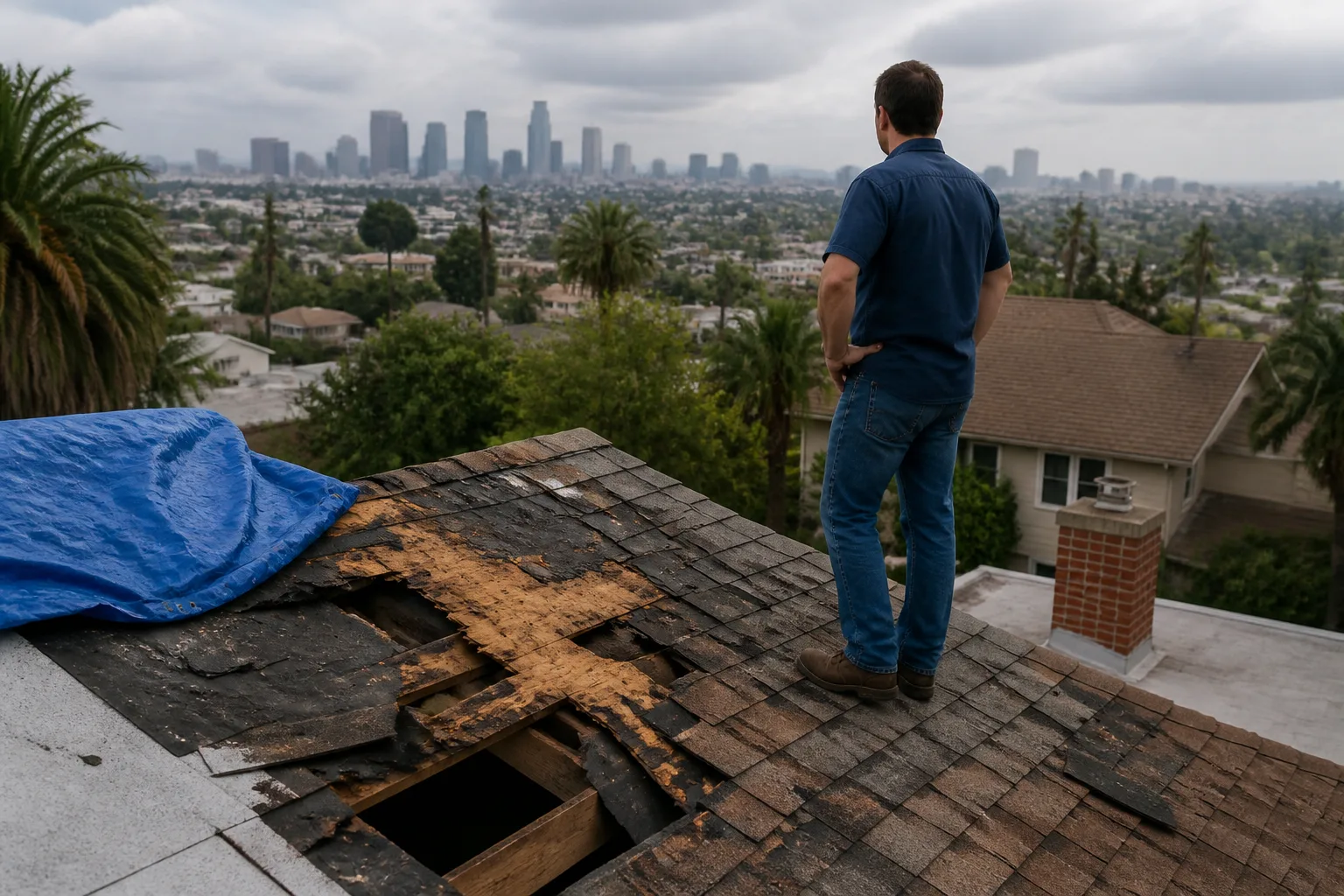
Emergency Roofing Company Near Me: What Los Angeles Homeowners Should Do First
If you’re standing in your living room watching water drip through the ceiling, the most important thing you can do is not panic and not climb onto the roof. In Los Angeles, the first 20 minutes after a roof emergency decide whether your insurance claim holds up and whether a temporary fix actually keeps water out. What you do before a contractor arrives matters more than the repair itself, so here is the calm, sequential checklist for those first critical minutes. If you’d rather skip the DIY containment and have a crew on the way now, call Tilehurst Roofing at (945) 303-9821.
Most Storm-Damage Claims Get Denied for One Preventable Reason
Most storm-damage insurance claims in Los Angeles aren’t denied because the damage wasn’t real. They get denied because the homeowner lets an unlicensed contractor throw a tarp on the roof before any documentation exists. The insurer’s adjuster then looks at the photos and sees a tarp, not the actual broken tiles or torn underlayment underneath it, and the claim starts from a position of doubt. We’ve walked homeowners through this exact situation more times than we can count, and the pattern is always the same: the damage happened, the tarp went up, the photos never happened, the claim stalled.
Before anyone touches your roof, before any tarp goes down, before you even call a contractor, do this. Take clear photos of the damage from inside the house and from the ground outside. Get the roof line, the specific damaged area, and any water staining on ceilings or walls. Then, write down the exact time the leak started or the moment you noticed the damage. Screen-capture the weather report showing the storm that hit your part of Los Angeles that day. These timestamps and photos are what a claims adjuster uses to confirm the damage is storm-related rather than pre-existing neglect. Skip this step and you’re handing the insurance company a reason to say no.
First-Hour Interior Containment: What to Do Without Getting on the Roof
During the first hour, your job is to keep water from turning a $700 repair into a $14,000 ceiling, floor, and drywall restoration. You do not need to get on the roof. In fact, you should not get on the roof, especially during or just after a Los Angeles rain event when steep pitches and clay tiles are slick enough to send you off the edge. The goal is interior containment, and it’s simpler than most people think.
Grab a bucket or any large container and put it directly under the drip. If the water is running along a ceiling joist and dripping in multiple spots, poke a small hole in the lowest point of the bulge with a screwdriver so the water drains into one controlled spot instead of spreading across the drywall. Then, lay plastic sheeting or a cut-open trash bag over furniture and flooring below the leak, and weigh down the edges. If the leak is near a light fixture, kill the circuit breaker to that room before anything else. Water and wiring don’t mix, and a short behind a wet ceiling is a fire hazard, not a hypothetical. Once the bucket is catching water and the floors are covered, you’ve done what a professional would do in the first hour, short of anything on the roof itself.
What a Legitimate Emergency Roofer in Los Angeles Must Provide Before a Tarp Goes Down
When a contractor knocks on your door after a storm or answers your “emergency roofing company near me Los Angeles” search, there are three things they must hand you before anyone climbs a ladder. First, a valid CSLB license number. The Contractors State License Board regulates roofing contractors in California, and a legitimate Los Angeles roofer will give you their number without hesitation. Second, proof of insurance. General liability and workers’ compensation should both be current. If they only have liability, that means if a worker falls off your roof, the injured worker can come after your homeowners policy, and you don’t want that. Third, a written scope of work that says exactly what the emergency temporary repair covers, what it costs, and what happens next. No written scope, no tarp.
Here is the part most homeowners miss. The tarp itself is a temporary repair, not a permanent fix. A proper emergency tarp in Los Angeles gets secured with battens, not just thrown loose and weighted down. It gets fastened around chimneys, vents, and valleys so wind doesn’t rip it off in the next Santa Ana event. And it gets documented with after-photos that go into your claim file. At Tilehurst Roofing, every emergency job includes a written guarantee on the temporary repair before the crew leaves, not mailed later. If the tarp fails inside the guarantee period, we come back at no charge under our 365-Day Done Right Promise. That’s the floor, not a premium add-on. If a roofer won’t put the temporary fix in writing, the next storm is your problem, not theirs.
Why “Free Emergency Tarp” Offers from Storm-Chasers Usually Cost Thousands
After a big storm in Los Angeles, out-of-town crews appear in the hardest-hit neighborhoods with flyers promising a free emergency tarp. The tarp is real, but it is rarely free. What they hand you to sign is often an assignment of benefits clause buried on page three. You’re agreeing to assign your entire insurance claim to that contractor, which means they negotiate with your insurer, they set the price, and you’ve handed over control of your claim before you’ve read the fine print. We’ve seen homeowners in Los Angeles sign these papers at 11 p.m. with a flashlight in one hand and a pen in the other, then call us months later trying to unwind a contract they didn’t understand.
The tell is simple. Legitimate emergency roofers in Los Angeles tell you the price of the tarp up front. A residential emergency tarp in LA typically runs $350 to $600 depending on the size of the damaged area and how difficult the roof is to access. That’s a real number you can budget around. A storm-chaser says the tarp is free and doesn’t want to discuss what anything else costs. When you hear “free,” slow down. Ask for a written scope. Ask for the license number. Ask what the next step costs. If the answer is vague, tell them you need 24 hours to think about it. A real roofer respects that. A storm-chaser needs you to sign tonight, and that urgency is the red flag.
How to Verify a Contractor’s CSLB License in Under 60 Seconds from Your Phone
The fastest way to separate a licensed Los Angeles roofer from a storm-chaser is to check the CSLB website right there on your phone. Open your browser, search “CSLB license check,” and enter the license number the contractor gave you. In under a minute, you’ll see the business name, the license status, the issue date, and whether there’s any record of discipline. Do this while the contractor is still standing at your door. If the license number doesn’t match the business name, or the status says anything other than active, or the person at your door refuses to give you a number at all, that’s the end of the conversation.
What most Los Angeles homeowners don’t realize is that a license number alone isn’t enough. You should also confirm the classification. Roofing work in California requires a C-39 roofing contractor license, not just any contractor’s license. A general contractor with a B license might legally do a full roof replacement, but a C-39 means the company’s primary trade is roofing and they’ve demonstrated specific competence to the state. Every Tilehurst Roofing technician carries current identification, and we’re transparent about our licensing and insurance before anyone steps onto a ladder. We’ve never asked a homeowner to trust that we’re legitimate. We’ve always been able to show them, on the spot, in writing.
What to Expect from a Real Los Angeles Emergency Roof Repair
Once you’ve documented the damage, contained the water inside, verified the license, and signed a written scope, the actual emergency repair usually moves fast. A two-person crew tarping a standard Los Angeles roof typically takes one to two hours on site. That includes setting up ladder safety, removing broken material that could fall, securing the tarp with battens, and photographing the finished work. Then, the permanent repair gets scheduled. In our experience, most emergency tarps hold for 30 to 60 days, which gives you time to file the insurance claim, get the adjuster out, and plan the permanent fix without water coming through the ceiling every time it drizzles.
The cost conversation should happen before the tarp, not after. Most emergency tarp jobs in Los Angeles run $350 to $600, as mentioned above. The permanent repair depends on the damage. A few broken asphalt shingles on a standard home might run $300 to $800. Replacing a section of damaged underlayment and flashing, which is the waterproof layer under your visible roofing material, usually lands between $800 and $2,500 depending on how much decking, the plywood layer underneath, got saturated. And if the storm tore off enough material that your roof needs a full replacement, Los Angeles homeowners typically see quotes from $14,000 to $30,000 for a standard single-family home, depending on size, material, and access. When we work with GAF or CertainTeed materials, the manufacturer warranty often adds real value, but that’s a conversation for the permanent scope, not the emergency call.
When to call a pro: If water is entering the house, if you can see daylight through the ceiling, if shingles or tiles have blown into the yard, or if the roof looks visibly sagging in one area, call a licensed Los Angeles roofer. This is not a DIY situation, and it’s not a handyman situation either. Roof leaks are dangerous, and a temporary patch from someone without roofing-specific training usually fails within weeks. If you’re in Los Angeles and need help, call (945) 303-9821 and we’ll give you a clear answer and a free estimate.
Related services in Los Angeles: If the damage is beyond a temporary fix, our Roof Repair in Los Angeles page walks through what repairs actually cost, and our Roof Replacement in Los Angeles page covers the full replacement process from material selection to final inspection.
The Bottom Line
The 20 minutes after a roof emergency are the difference between a straightforward claim and a denied one, between a $600 tarp and a $14,000 restoration. Document before anyone touches anything. Contain the water inside without getting on the roof. Verify the license before the tarp goes down. Get the price in writing before any work starts. And never let a “free” emergency tarp rush you into signing away your claim. If you’re in Los Angeles and need help, Tilehurst Roofing offers free estimates and a live person answers the phone 24 hours a day. Call (945) 303-9821 and we’ll walk you through exactly what to do next.
Frequently Asked Questions
Most emergency roofing calls in Los Angeles see a crew arrive within two to four hours, depending on weather conditions and call volume. Severe storm events can extend that window because every company in the city is responding at once, so call as soon as you’ve documented the damage and contained the water. We answer calls with a live person around the clock, so you’ll know your time frame before you hang up. Call (945) 303-9821 to get on the schedule right away.
Insurance typically covers storm-related roof damage, but only if you can prove the damage was caused by the storm and not by deferred maintenance. That’s why photos and timestamps taken before any repair work begins are so important. Document the damage, keep the weather report, and file the claim before or immediately after the emergency tarp goes up. We help Los Angeles homeowners navigate this process on every storm job we take.
A residential emergency tarp in Los Angeles typically costs between $350 and $600 depending on the size of the damaged area, the roof’s pitch, and how difficult it is to access. That should include labor, materials, and written documentation for your insurance claim. Be wary of “free” tarp offers from storm-chasers, which often come with assignment of benefits clauses that hand your entire claim to the contractor. For an exact quote on your home, call (945) 303-9821.
No. Los Angeles roofs get steep and slick, especially with rain, clay tile, or accumulated debris, and a fall from even a single-story roof can be life-changing. Document what you can see from the ground and from inside the house, contain the water inside, and let a licensed inspector do the roof walk. We’d rather you call us to look than call an ambulance for you. Our technicians carry the right equipment and training to inspect safely.
Written by Greg Holloway, Owner at Tilehurst Roofing, serving Los Angeles since 2000.
Need Roofing Help?
Call Tilehurst Roofing - licensed & insured, here with fast after-hours help in Los Angeles.
(945) 303-9821