
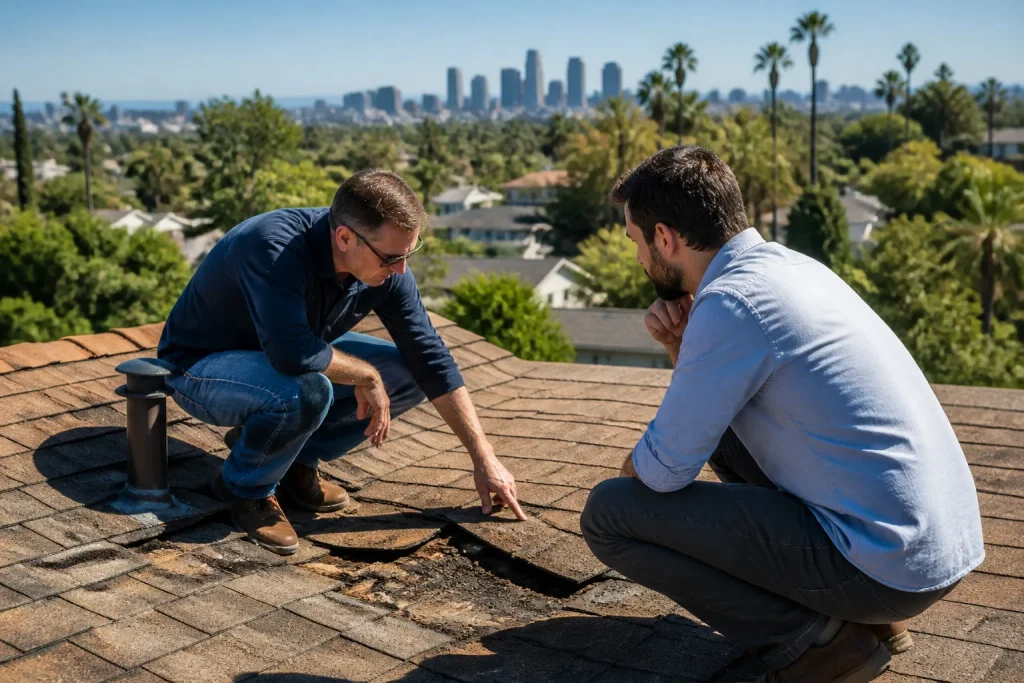
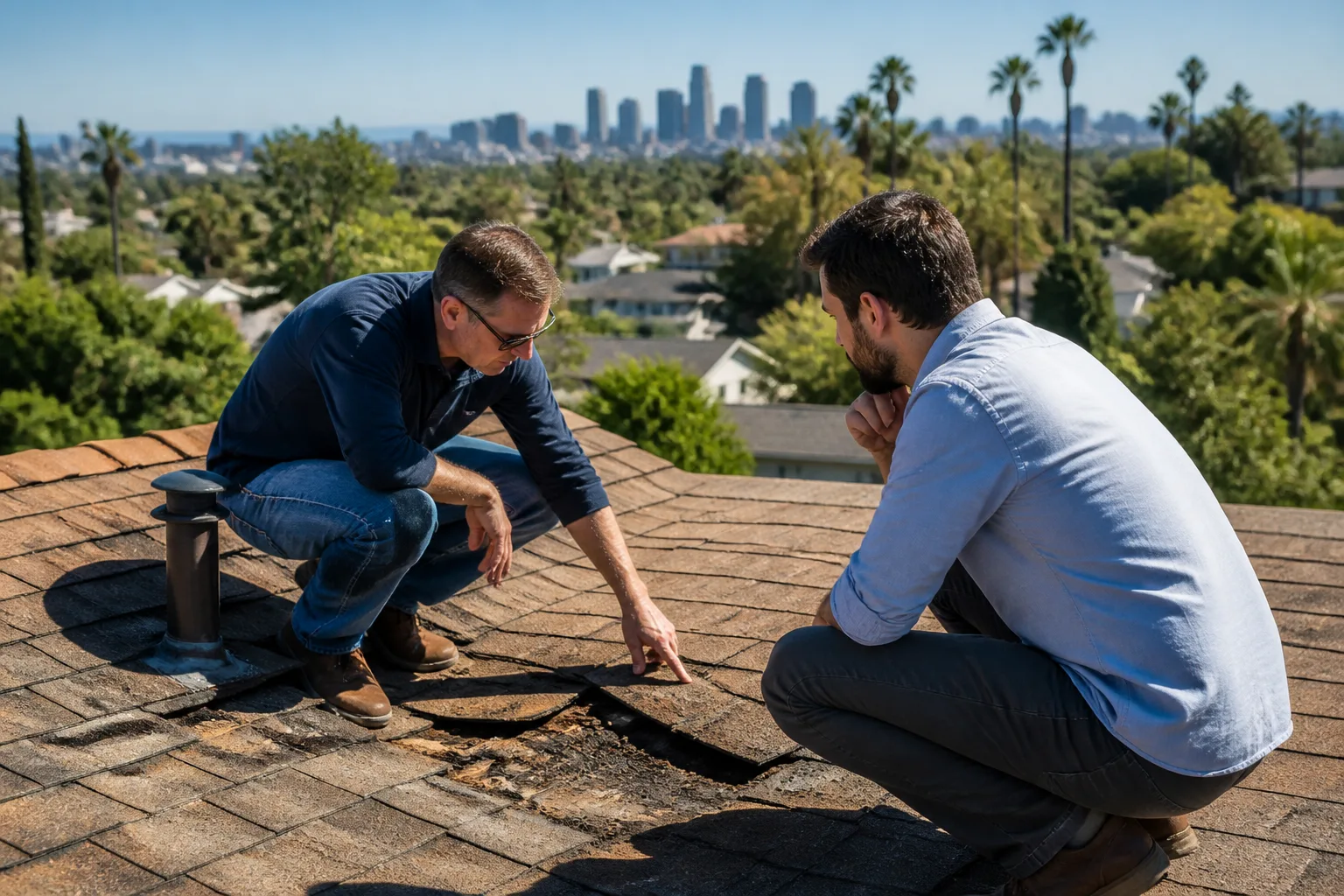
Roofing Company: Repair or Replace? How Los Angeles Homeowners Decide
Most Los Angeles homeowners don’t actually decide between repair and replacement. The contractor who shows up first makes that call, and their recommendation often says more about their business model than your roof. Here’s the framework we use: if your roof is under 12 years old and the damage is localized, repair usually wins. If it’s over 20 years old with wear across multiple slopes, replacement is almost always the smarter ten-year financial decision. If you’d rather skip the research and get a straight answer, call us at (945) 303-9821 for a free estimate.
The 50% Rule: A Practical Starting Point
Most roofing crews in Los Angeles work off some version of this guideline, whether they tell you or not: when the cost to repair exceeds half the cost of full replacement on a roof older than 15 years, replacement wins on a ten-year cost basis. Here’s the math in real dollars.
Let’s say your asphalt shingle roof over a 1,800-square-foot Los Angeles home needs new flashing around two chimneys, a resurfaced section over the garage, and decking replacement along one eave. That repair might run $6,500 to $9,000. A full replacement of the same roof might cost $14,000 to $19,000. The repair absorbs 45 to 55 percent of the replacement cost. On a roof with 18 years already on it, you’re buying maybe three to five more years before the next repair. You haven’t saved money. You’ve financed the replacement in installments without interest going your way.
- Under 10 years old, localized damage: repair is usually right unless the decking underneath is compromised.
- 12 to 17 years old, repair at 30-50% of replacement cost: this is the judgment zone. Look at granule loss, decking condition, and how long you plan to stay in the home.
- Over 18 years old, repair at 50%+ of replacement cost: replacement almost always wins on any runway beyond six years.
Greg Holloway has walked more Los Angeles roofs than he can count, and the pattern is consistent: homeowners who patch a 20-year-old roof twice end up paying more than the homeowner who replaced it the first time someone finally told them what was really going on up there.
What Los Angeles Insurance Doesn’t Tell You Until Renewal
Here’s the factor most articles about Roofing Company in Los Angeles skip entirely: insurance carriers are quietly changing the repair-or-replace math. Several major insurers writing policies in Southern California now surcharge or non-renew homes with roofs over 20 years old. Some carriers require a roof inspection before binding a new policy. Others won’t write a policy at all if the roof shows more than a certain percentage of wear, regardless of whether it currently leaks.
What this means for your decision: you may not get to choose repair. Your renewal letter may choose for you. We’ve seen Los Angeles homeowners in neighborhoods like Woodland Hills, Sherman Oaks, and Silver Lake get non-renewal notices that require either a certified roof inspection showing five-plus years of service life, or documentation of a full replacement within 60 to 90 days.
If your roof is between 18 and 22 years old, check your policy renewal terms before you spend on repairs. A $7,000 repair done in March may not stop your carrier from non-renewing in September. Ask your agent directly: “Will a repair satisfy the roof condition requirement, or do you need replacement documentation?” Get the answer in writing. If the carrier requires replacement, the repair budget becomes the first payment toward the bigger job instead of a sunk cost on a roof the insurance company won’t cover anyway.
Three Conditions That Make Repair a Bad Investment, Period
Some roofs look fine from the ground and are done from the deck up. These are the three conditions where we tell Los Angeles homeowners to stop repairing, regardless of what any estimate says:
1. Widespread decking rot
Decking is the wood layer under your shingles. In Los Angeles, we don’t deal with the constant moisture other climates do, but we do deal with long dry seasons broken by sudden heavy rain, marine layer condensation near the coast, and Valley heat that bakes moisture into trapped spaces. When decking rots across more than 25 to 30 percent of the roof surface, repairing the visible damage means nailing new shingles into compromised wood. You’re installing a warranty on a foundation that can’t hold it.
2. Systemic flashing failure
Flashing is the metal that seals the joints where your roof meets chimneys, walls, vents, and valleys. A single failed flashing point is a simple repair. But when flashing is failing at multiple penetrations across the roof, the problem is almost always age and material fatigue, not a one-off event. You’ll chase leaks one by one, paying a service call each time, while water works its way under shingles and into places you won’t see until the ceiling stains.
3. More than 30 percent granule loss
Granules on asphalt shingles are the UV protection and waterproofing surface. When more than a third of the granules are gone, the shingles are in the final phase of their service life. You’ll see it as bald spots, granules collecting in gutters, and a roof that looks washed out. At that point, patching is cosmetic. The roof is already failing, just not visibly from the street.
If you’re seeing any of these three conditions and want a second data point before you commit, call (945) 303-9821. We’ll tell you what we see and what we’d do if it were our house.
Questions That Reveal Whether a Recommendation Is Real or Margin-Driven
Most Los Angeles contractors aren’t dishonest. But they do have preferences, and those preferences are shaped by their staffing, their material contracts, and what they’re set up to sell this quarter. The point isn’t to distrust the person on your roof. The point is to verify their reasoning with a framework you control.
Here are the questions that separate condition-based advice from sales positioning:
- “Can you show me the specific areas you’re recommending and explain what you’re seeing in each one?” A real roofer can point at the valleys, the penetrations, the slope with granule loss. If the answer is vague, the recommendation is vague.
- “What would you do if this were your house and you planned to stay five years?” Then listen for the pause. Candid roofers answer without recalibrating.
- “What’s the remaining service life of the roof if we do nothing?” If they can’t estimate remaining life, they haven’t actually assessed condition. They’re estimating price.
- “Does repair change anything with my insurance renewal?” This question signals you know about the carrier issue. It changes the conversation.
- “Can I get your recommendation in writing with the condition data included?” At Tilehurst Roofing, a written price before any work starts is standard. If a contractor won’t put the assessment in writing, ask yourself what they’re protecting.
We’ve had Los Angeles homeowners call us after another company quoted a full replacement on a roof that needed one section of flashing and a ridge cap. Not because the other company was bad. Because the other company’s estimator had a replacement quota and a short week to hit it. Your questions are your leverage.
Partial Re-Roofs: The Los Angeles-Specific Middle Option
One option that gets lost in the repair-versus-replace binary is the partial re-roof: replacing one slope, one section, or one plane of the roof while leaving the rest intact. This makes real sense in specific Los Angeles scenarios.
Think about the classic LA addition, where a 1960s ranch got a second floor or a permitted addition in the 1990s. The original roof and the addition roof age at different rates. If the addition’s roof is failing while the original slope still has ten years left, a partial re-roof of just that section might cost $5,000 to $8,000 versus $17,000 for full replacement. That’s real money kept in your pocket for a section replacement that may buy you until the whole roof is ready to come off.
Flat-to-pitched transitions are another LA pattern. Many mid-century homes have a flat section over a carport or patio that drains poorly. That flat section fails years before the pitched main roof. Replacing just the flat section, including new underlayment and a modern membrane, makes sense when the pitched roof is healthy.
The catch: partial re-roofs require a contractor who will tell you when the section approach is wrong. If the underlying decking on a partial section is rotted, or if the section is so integrated with adjacent slopes that matching becomes impossible, the partial job creates a seam that leaks. A contractor who values the 365-Day Done Right Promise won’t recommend a partial re-roof that can’t be guaranteed. At Tilehurst Roofing, our guarantee on every repair and partial section is written before the crew leaves, not mailed later. That’s the Kingswell Way: say the price before the work, show up in the window we gave, and put the guarantee in writing.
Material Choices Change the Decision Too
Repair versus replace isn’t only about labor cost. It’s about what you’d replace with. Los Angeles homes run the full range: Spanish tile, asphalt shingle, flat membrane, metal accents on modern builds. If you’re repairing a 1980s three-tab asphalt roof, you’re buying time on a product that was obsolete decades ago. If you’re replacing, you’re choosing from architectural shingles that carry 30 to 50-year warranties and hold up to LA’s UV exposure far better than anything installed when Reagan was president.
We stock and install materials from seven manufacturers: GAF, CertainTeed, Owens Corning, IKO, Atlas, Tamko, and Boral. That doesn’t mean you need to memorize a spec sheet. It means when we recommend a product, it’s because the product fits your home, not because it’s the only thing in the truck. A homeowner in the San Fernando Valley with full sun exposure might do better with a heavier architectural shingle from Owens Corning or Atlas. A coastal home in Playa del Rey dealing with salt air and marine layer might benefit from certain products over others. Your house and your microclimate should drive that choice, and that’s the conversation we’d rather have than a default recommendation.
When to Call a Pro
You need a professional roofing assessment when you see water stains on ceilings, granule buildup in gutters after heavy rain, shingles lifting in multiple spots, or daylight coming through the attic. These are not DIY observations. Walking a roof is dangerous, and spotting decking rot requires training. If you’re in the Los Angeles area and want an honest read on whether your roof needs Roof Repair in Los Angeles or full replacement, call (945) 303-9821. The estimate is free, and the written price lands in your hands before any work starts.
Related services in Los Angeles: Roof Replacement in Los Angeles for homes at the end of roof life, and full roofing services from Tilehurst Roofing home.
The Bottom Line
Here’s what we’d tell you over a cup of coffee at a Los Angeles job site: repair makes sense on younger roofs with localized damage. Replacement wins on roofs past 18 years, roofs with structural decking issues, and roofs your insurance company won’t renew. The 50% rule is your best starting framework. Your insurance carrier’s roof requirements are the hidden variable. And asking the right questions keeps you from accepting a recommendation built on someone else’s margin rather than your roof’s actual condition.
If you’re in Los Angeles and want a straight answer with the condition data behind it, Tilehurst Roofing offers free estimates. Call (945) 303-9821. A live person answers, day or night, and you’ll have a written price before anyone picks up a hammer.
Frequently Asked Questions
Most asphalt-shingle repairs in Los Angeles run $500 to $2,500 for localized issues like flashing or a few missing shingles. A full roof replacement for an average LA home typically ranges from $14,000 to $25,000 depending on size, material, and decking condition. Call (945) 303-9821 for an exact quote, free of charge.
Check three things: the roof’s age, whether granule loss exceeds 30 percent of the surface, and whether decking shows rot in more than a quarter of the roof. If the roof is under 12 years old and damage is localized, repair is usually right. If it’s over 18 years old with systemic wear, replacement usually saves money over ten years.
Possibly, especially if your roof is over 20 years old. Several carriers writing LA policies now require roof inspections, surcharge older roofs, or non-renew policies with documented roof wear. Check your renewal terms before spending on repairs, and get the carrier’s roof requirement in writing.
Yes. Partial re-roofs work well on additions, flat-to-pitched transitions, and sections that failed independently of the main roof. A partial section replacement typically runs $5,000 to $8,000, but only makes sense when the adjacent roof has real service life left. Call (945) 303-9821 and we’ll tell you if partial replacement works for your specific roof.
Written by Greg Holloway, Owner at Tilehurst Roofing, serving Los Angeles since 2000.
Need Roofing Help?
Call Tilehurst Roofing - licensed & insured, here with fast after-hours help in Los Angeles.
(945) 303-9821