
Roofing Company What It Really Costs: What Los Angeles Homeowners Pay in 2026
In 2026, a full roof replacement on a typical Los Angeles home runs between $11,000 and $28,000, with most asphalt shingle jobs landing around $14,000 to $18,000. That’s a wide range, and it exists because two quotes can look identical at the top but be built on completely different assumptions underneath. If you’d rather not spend your weekend decoding line items, call (945) 303-9821 and we’ll walk you through it in plain English.
Two homeowners in Los Angeles with identical 2,000 square foot ranch homes get quotes of $14,000 and $23,000 from two different licensed contractors. Both numbers can be completely honest. Understanding why requires reading past the total and into the line items.
What the Average Los Angeles Roof Actually Costs in 2026, by Material
Los Angeles is a three-roof town. You’ve got asphalt shingle on most of the older ranches from the Valley down to South LA, clay or concrete tile on the hillsides and Spanish-style homes across the Westside, and flat TPO or modified bitumen on the mid-century moderns in places like Palm Springs-adjacent neighborhoods or the post-and-beam homes tucked into Laurel Canyon. Each roof type costs differently to replace, and within each type, the range is driven by real decisions: decking condition, access, tear-off complexity, and material grade.
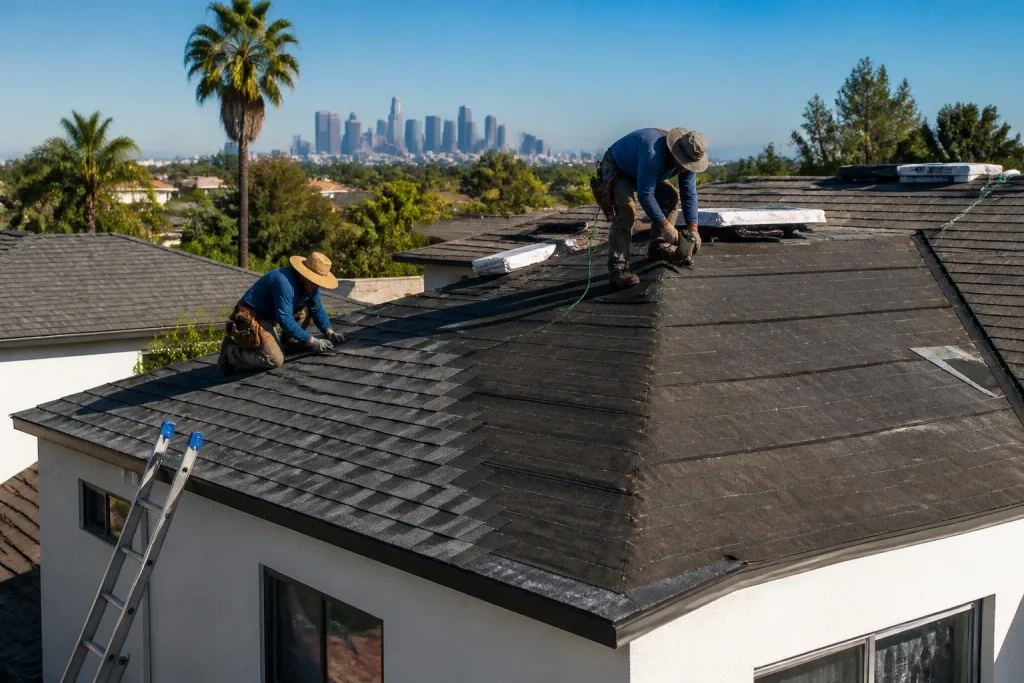
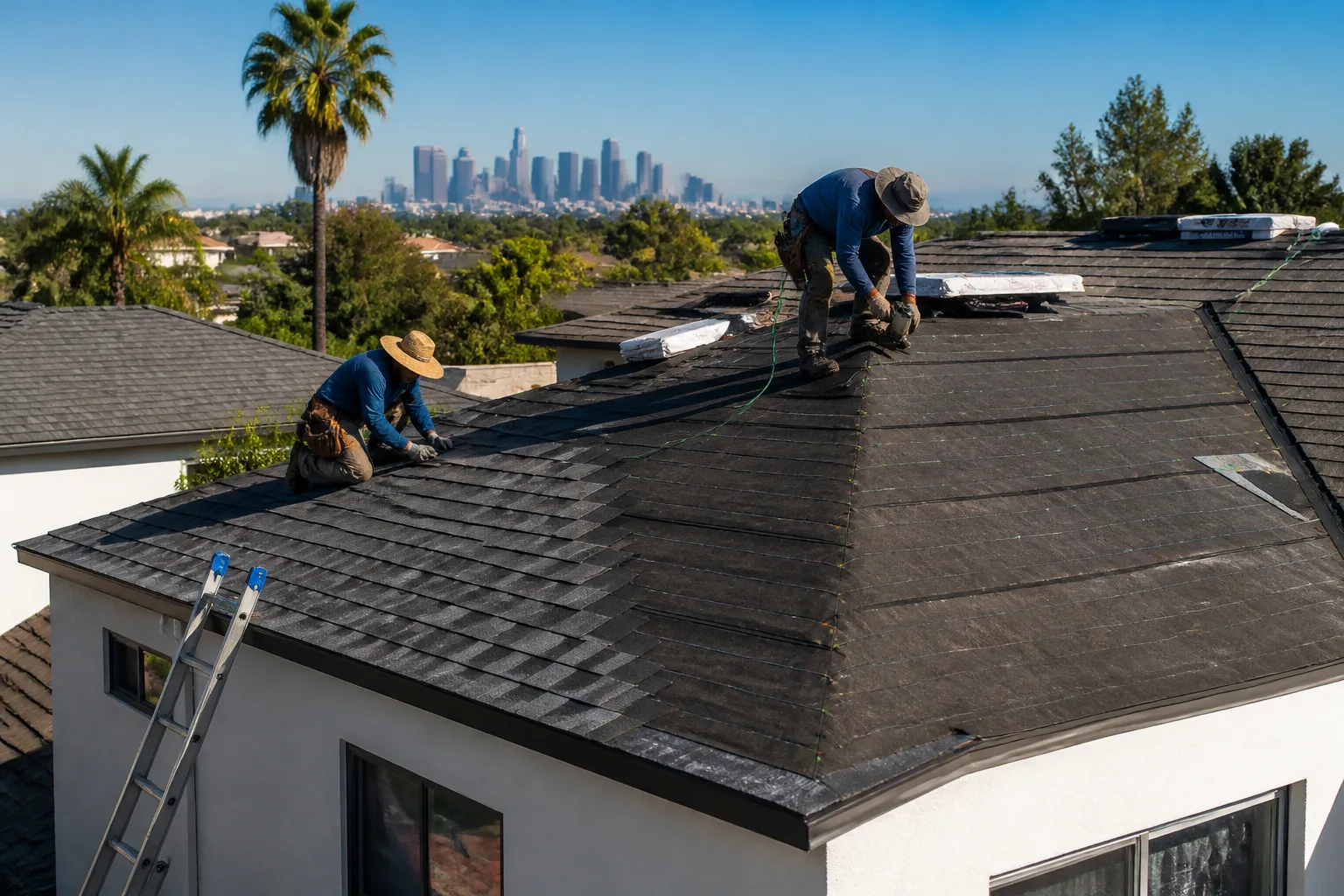
Asphalt shingle: $11,000 to $18,500
On a standard 2,000 square foot home, architectural asphalt shingles from GAF or CertainTeed typically run $550 to $700 per roofing square (100 square feet of roof area). That’s installed, with tear-off, underlayment, drip edge, and basic flashing. The low end assumes the existing decking is solid and the roof is a simple gable with no valleys. The high end reflects homes in Echo Park or Highland Park with steep pitches, multiple valleys, and decking that needs replacing.
Clay or concrete tile: $22,000 to $48,000
Tile is the most expensive common roof in Los Angeles because it’s heavy. Underlayment for tile is upgraded to a high-temp, dual-layer system, and the tiles themselves are individually placed rather than nailed down in strips. A concrete tile roof on a 2,000 square foot home in Brentwood or Pacific Palisades commonly lands between $22,000 and $35,000. Clay tile from Boral pushes higher. If the home needs a structural engineering report because you’re replacing tile with new tile on an older frame, that’s another $800 to $2,500 before the first tile is ordered.
Flat roof (TPO or modified bitumen): $9,500 to $16,000
Flat roofs cover less square footage per home but cost more per square because the system is more labor-intensive. TPO, a white single-ply membrane, runs $850 to $1,100 per square. Modified bitumen, the torch-down or peel-and-stick asphalt system, runs $700 to $950 per square. Homes in West Hollywood and the flats of Mid-City are the typical candidates. The range reflects whether the existing roof has one layer or three, and whether the parapet walls need new cap flashing.
These are 2026-calibrated for Los Angeles. National averages won’t help you here, because our disposal fees, permit costs, and labor rates are all higher than the national baseline.
Line Items Every LA Roofing Quote Should Include, and What They Actually Mean
A roofing quote that reads “complete roof replacement: $16,500” with no breakdown is not a quote. It’s a number. Here’s what a real Los Angeles roofing quote should itemize, and what each line represents.
- Tear-off and disposal: $80 to $150 per square. Landfill fees in Los Angeles County have risen steadily, and a full tear-off of a 2,000 square foot home produces 3 to 5 tons of debris. If a quote includes “tear-off included at no charge,” it’s in the price somewhere. You just can’t see where.
- LADBS permit fees: $400 to $1,200 depending on the scope. The Los Angeles Department of Building and Safety charges based on project valuation. A contractor who suggests skipping the permit is asking you to carry the risk. Don’t.
- Decking replacement allowance: $75 to $110 per sheet, usually written as “up to X sheets included.” Most quotes include 2 to 4 sheets. If the decking is rotted beyond that, the additional sheets become a change order. A quote with zero decking allowance is a quote that’s planning to surprise you after tear-off.
- Valley and flashing material: $800 to $2,500 depending on linear feet. Valleys are where two roof planes meet. They fail first. The flashing system is the most common place a cheap quote cuts corners, because you can’t see it from the street and you won’t know it failed until the ceiling stains.
- Drip edge and ridge cap: $500 to $1,200 combined. Drip edge keeps water from wicking under the shingle at the eaves. Ridge cap vents the attic. Both are required by current LA code. A quote missing either line is out of code compliance.
We write every Tilehurst Roofing quote with these line items separated, so you can compare a $14,000 bid against a $17,000 bid and see exactly what each one includes. That’s a Kingswell Way practice: the price is in writing before any work starts, and nothing in the line items is negotiable after the fact.
Cost Variables Specific to Los Angeles That National Guides Ignore
Los Angeles is not a generic market. Three variables show up repeatedly in our work, and none of them appear in a national roofing cost calculator.
Hillside access surcharges
Homes in Silver Lake, Eagle Rock, Bel Air, and the Hollywood Hills often sit on slopes that make it impossible to stage materials at the curb or park a dump trailer within 100 feet of the house. Crews walk shingles up by hand or set up a conveyor, and the city may require a no-parking permit to hold the street. Hillside access adds $1,500 to $5,000 to a job, depending on slope steepness and street width. It’s not a markup. It’s the cost of carrying 10,000 pounds of material up a hill.
HOA material approval delays
If your Los Angeles home sits in an HOA with architectural review, the association may require you to submit material samples and roofing specs before work starts. That process takes 2 to 8 weeks, and if the HOA denies your first choice, you may be back to the drawing board. Some contractors charge to hold a spot on the schedule during the delay. Others don’t. Ask before you sign.
Structural engineering for tile-to-tile replacement
Older homes in Pasadena, San Marino, and the hills around Studio City were often built when framing standards assumed a lighter tile load. If you’re replacing an existing tile roof with new tile on a home built before the early 1990s, LADBS may require a structural engineer to verify the framing can carry the new system. A structural report runs $800 to $2,500 and can add 2 to 3 weeks to the project timeline. We’ll tell you upfront whether your home is a likely candidate, rather than discovering it at the permit counter.
Insurance, Supplements, and Financing: What Affects What You Actually Pay
The price on a roofing quote is not always the price you pay out of pocket. Homeowner’s insurance, the supplement process, and financing terms all change the final number.
When insurance covers the replacement
In Los Angeles, homeowner’s insurance typically covers a roof replacement only when the damage results from a covered peril: wind, hail (rare here but not unheard of in the Antelope Valley edges), tree impact, or fire. The claim requires documentation: photos of the damage, a contractor’s written assessment, and often an adjuster’s inspection. The key trigger is “sudden and accidental” damage, not wear and tear. A roof that’s simply old, with granule loss and failing sealant, is maintenance. That’s on you. A roof with a tree branch through the decking is a claim. We’ll tell you honestly which one you’re looking at before you spend time on a claim that will be denied.
The supplement process, understood
A supplement is what happens when the crew tears off the old roof and finds damage the adjuster couldn’t see from the ground. Rotted decking behind the chimney. Water damage under the old underlayment. The contractor documents it with photos and submits a supplement to the insurance company, asking for additional funds to cover the newly discovered damage. This is normal, legitimate, and common. What matters is that the contractor communicates the supplement before doing the extra work, with a clear explanation of what changed. If a contractor tells you the supplement is “just paperwork and you don’t need to worry about it,” ask for it in writing anyway.
How financing changes the total over time
Most Los Angeles roofing companies offer financing through third-party lenders. A $16,000 roof financed at 9.9% over 10 years costs about $25,000 by the time it’s paid off. At 0% for 12 months, same roof, no interest if you pay it off inside a year. The lesson is plain: financing is a tool, not a discount. If the cash price and the financed price are different, the “free” financing isn’t free. Ask the contractor to show you both numbers side by side before you choose.
How to Compare Two Quotes That Look Different and Both Seem Honest
This is the moment most Los Angeles homeowners get stuck. Two licensed contractors. Two legitimate quotes. Four thousand dollars apart. Here’s the framework we use when a customer asks us to explain the difference.
First, look at the line items. A quote that’s missing tear-off, disposal, or a decking allowance is not cheaper. It’s incomplete. The missing items will appear as change orders after the old roof comes off, and the final price will land at or above the higher quote’s total anyway. A quote that itemizes everything and is still lower is usually a legitimate lower bid: the contractor has lower overhead, a shorter backlog, or runs a tighter crew.
Second, look at the material spec. A quote that says “architectural shingle” without naming a manufacturer is giving you a range, not a price. Owens Corning Duration is not the same as a builder-grade GAF shingle, and the difference is $80 to $150 per square. If the quote spec doesn’t list brand and product line, ask for it. In writing.
Third, check for the three things that should always be in writing before any work starts in Los Angeles: the price (itemized, including permit fees), the scope (what’s included and what’s excluded), and the warranty (what’s covered, for how long, and what triggers a free return visit). If any of those three is missing, the quote isn’t ready for your signature.
The Kingswell Way is built on this exact principle. Say the price before the work. Show up in the window we gave. Leave the place cleaner than we found it. Put the guarantee in writing. Come back if it fails. That’s not marketing copy. It’s the operating manual.
What a Written Guarantee Should Look Like in Los Angeles
Every roof in Los Angeles fails eventually. Sun exposure is relentless here, and the temperature swings between Santa Ana heat and June gloom cycles stress every roof system. A guarantee matters because it tells you what happens when a repair or replacement doesn’t hold up.
Here’s what we put in writing on every Tilehurst Roofing job: if a repair fails inside the guarantee period, the crew returns to correct it at no charge. That’s the 365-Day Done Right Promise on our end: a full year of documented accountability. The guarantee is delivered before the crew leaves, not mailed later. And if the repair fails, the second visit is free. No diagnostic fee, no “that’s a different issue” conversation, no waiting through a callback queue.
Now, a written guarantee isn’t unique to us. Any contractor worth hiring in Los Angeles should provide one. The question is what it covers and whether it’s in writing. A verbal guarantee is a rumor. A written guarantee with a covered period and a clear return policy is a contract. Ask for the second one.
The Bottom Line
Roofing costs in Los Angeles in 2026 run $11,000 to $28,000 for a full replacement, depending on material, access, and the condition of what’s underneath. Asphalt shingle sits at the low end, clay and concrete tile at the high end, and flat roofs land somewhere in between. The number that matters isn’t the bottom line on the quote. It’s the line items, the material spec, the permit approach, and the written guarantee. A $14,000 quote that’s missing disposal and decking allowance will cost you $18,000 by the time the change orders land. A $17,000 quote that itemizes everything and puts the warranty in writing is the better number.
If you’re in Los Angeles and need help sorting through your options, Tilehurst Roofing offers free estimates. We’ll walk the roof, show you what we see, and put a written price in your hands before any work starts. Call (945) 303-9821. A live person answers, day or night.
Need a full replacement rather than a fix? You can learn more on our Roof Replacement in Los Angeles page. Or if you’re not sure whether the roof needs work at all, start with Roof Repair in Los Angeles.
We pulled a strip of old modified bitumen off a flat roof in Atwater Village last month where the previous contractor had skipped the drip edge entirely to save about $600 on a bid. The homeowner had the receipt for a “complete” roof replacement, and water was already staining the eaves a year later. That’s what a missing line item looks like from underneath.
When something like that happens, it usually means whoever installed the roof treated the quote as a ceiling instead of a floor. If you’d rather not learn the difference from the inside of your living room, call (945) 303-9821. We’ll give you a number that means what it says.
Frequently Asked Questions
A full roof replacement in Los Angeles runs $11,000 to $28,000 in 2026, with most asphalt shingle jobs at $14,000 to $18,000, tile roofs at $22,000 to $48,000, and flat roofs at $9,500 to $16,000. The exact price depends on material, access, decking condition, and permit requirements. Call (945) 303-9821 for a free estimate specific to your roof.
Two quotes $4,000 apart can both be honest if one includes tear-off, disposal, decking allowance, and LADBS permit fees, and the other leaves those as post-contract change orders. The lower quote isn’t always cheaper. Compare line items, not total prices. If you want a second set of eyes on a quote, call (945) 303-9821 and we’ll walk through it with you.
Insurance covers replacement only when damage is sudden and accidental: wind, tree impact, fire, or similar covered perils. Normal aging, granule loss, and failed sealant are maintenance and typically excluded. If you’re not sure which category your roof falls into, we can assess it before you file. Call (945) 303-9821 for a straightforward read.
Three things: the itemized price including permits and disposal, the full scope of work including exclusions, and the warranty terms including what triggers a free return visit. If a contractor won’t put those in writing, the quote isn’t ready to sign. Tilehurst Roofing puts every price and guarantee in writing before work begins, and you can reach us at (945) 303-9821 anytime.
Written by Greg Holloway, Owner at Tilehurst Roofing, serving Los Angeles since 2000. Looking for a broader overview? Start with our Roofing Company in Los Angeles page.
Need Roofing Help?
Call Tilehurst Roofing - licensed & insured, here with fast after-hours help in Los Angeles.
(945) 303-9821