
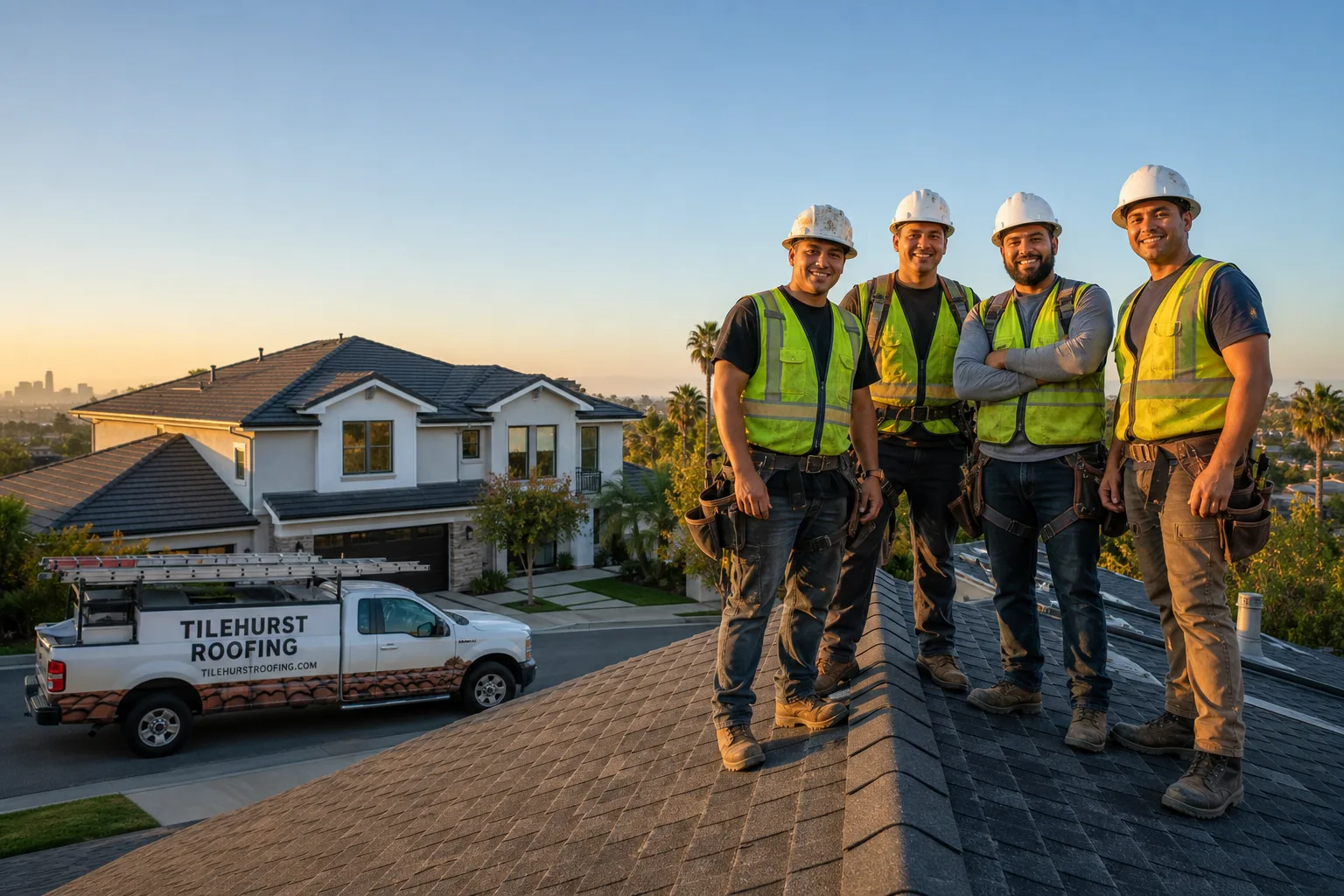
Free roof inspection with deck photos before we talk money - GAF and Owens Corning certified installation
 Before
 After
After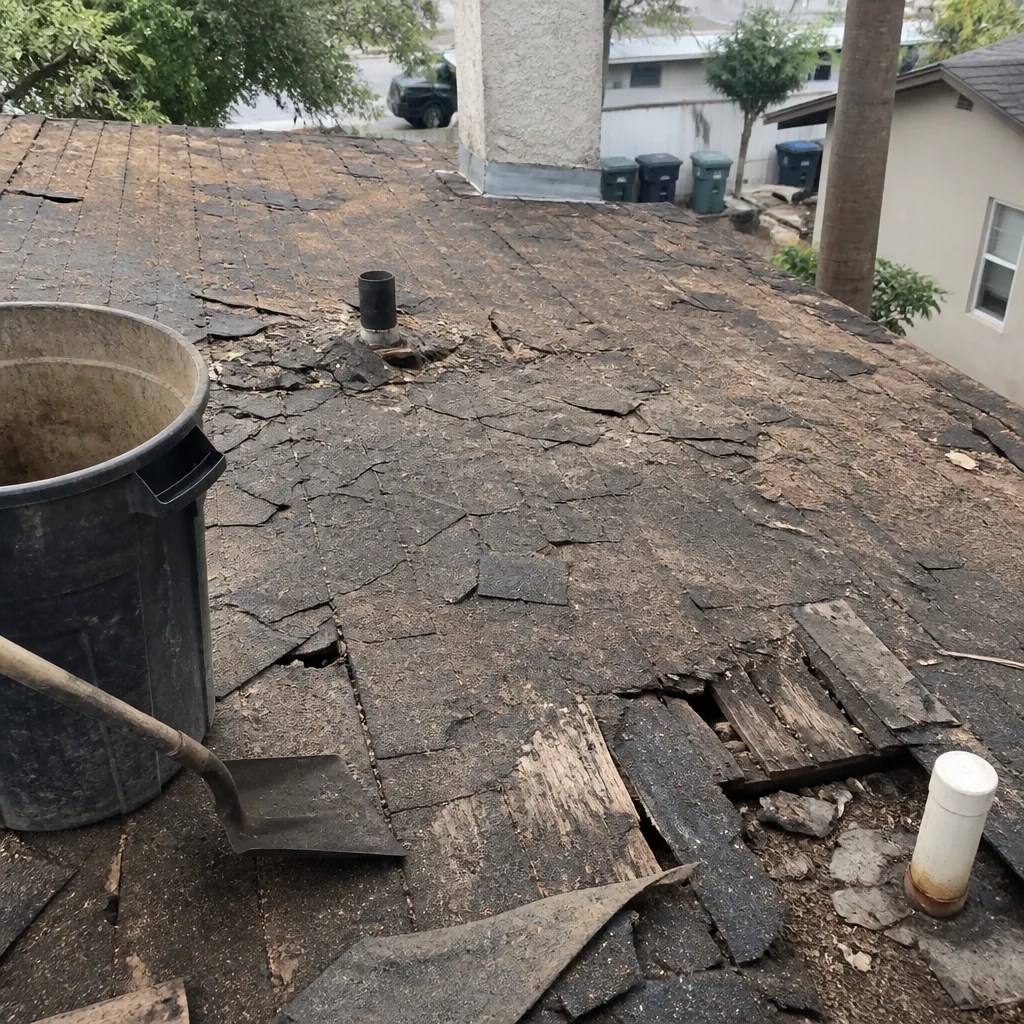 Before
 After
After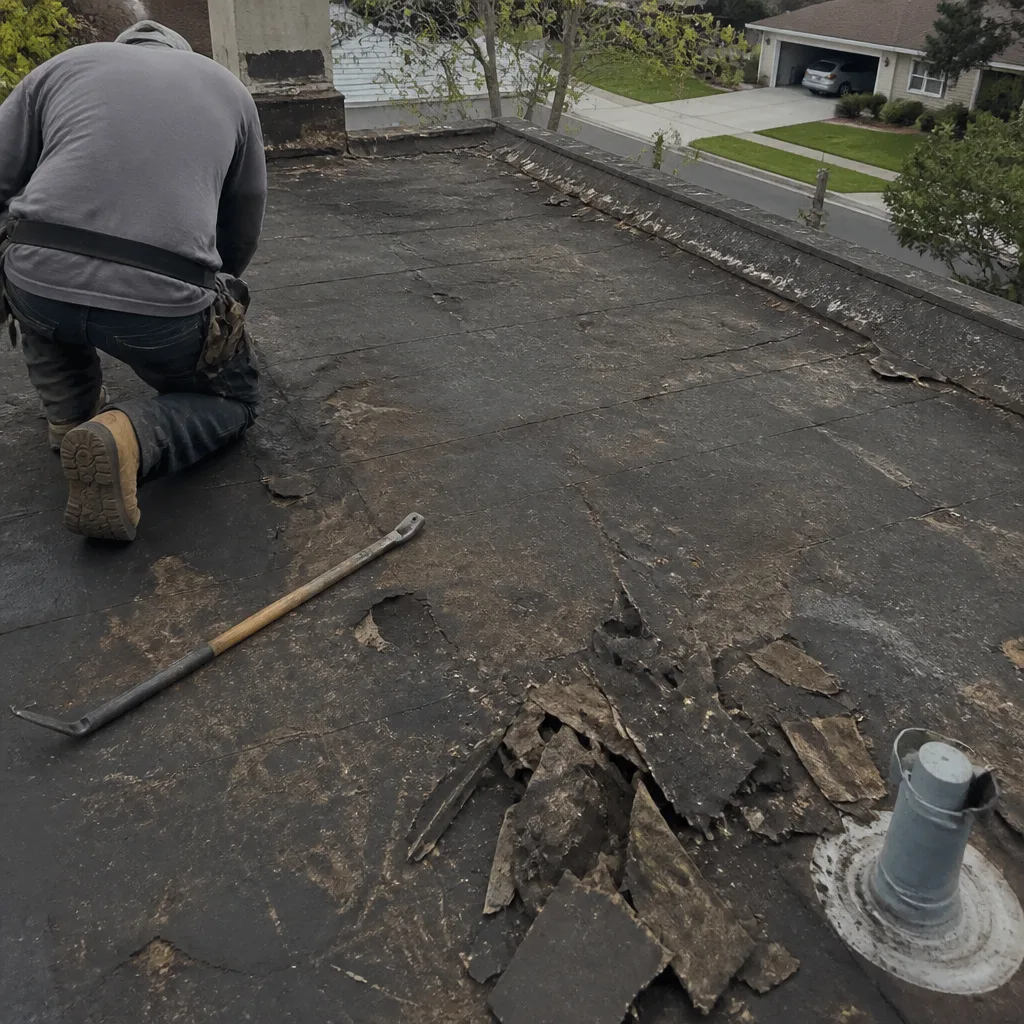 Before
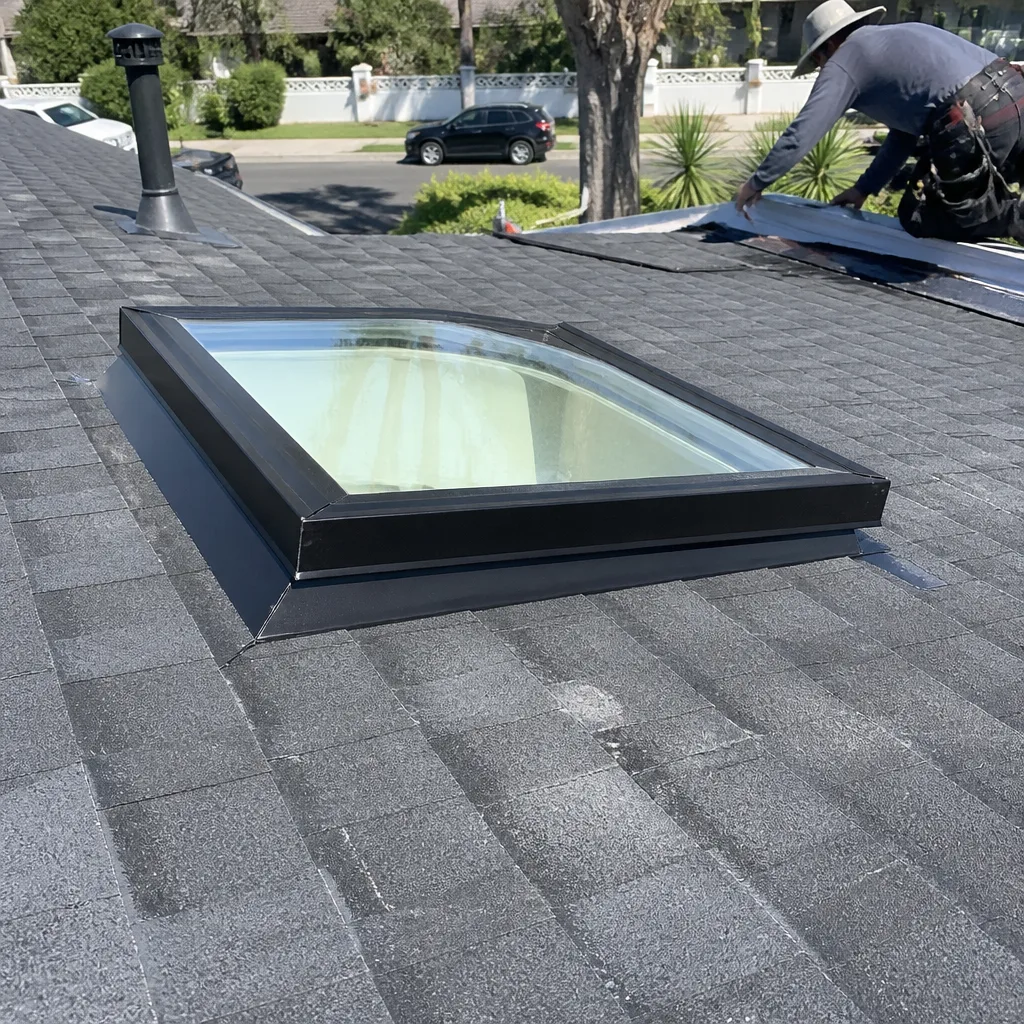 After
AfterFast, Reliable Roof Repair Across Corona
Most roof repairs in Corona run between $350 and $1,400 depending on what’s actually failing, and the honest truth is that many Corona homeowners call us for one problem and we find a different one. That’s not upsell – it’s how tile roofs in this city age. The underlayment goes bad years before the tile does. If you’ve got a stain, a lifted tile, or a ridge cap that cracked during the last Santa Ana blow, call (945) 303-9821 and we’ll walk the roof, tell you what we see, and put a written price in your hands before any work starts.
Key Takeaways
- Most Corona tile roofs start failing invisibly: 15-lb felt underlayment chalks and tears beneath intact-looking concrete tile, and eave decking rots before ceilings stain.
- Typical repair ranges in Corona: leak repair $350-$900, flashing replacement $400-$950, flat roof patch $500-$1,200, underlayment section replacement $900-$2,500.
- Santa Ana winds funneling through Temescal Canyon crack ridge-cap mortar and blow caps off regularly – we reset and re-mortar those constantly.
- Every repair from Tilehurst Roofing includes a written price before work starts, a written guarantee before the crew leaves, and a free second visit if the repair fails inside the guarantee period.
- Call (945) 303-9821 for a free estimate – a live person answers, 24/7.
Why Tilehurst Roofing Is Corona’s Preferred Roof Repair Company
Corona homeowners have told us the same stories over and over: the roofer who quoted one number and changed it at the door, the crew that showed up two days late, the repair that lasted three months and failed in the first rain. That’s exactly why Tilehurst Roofing exists. We’re a local member of the Kingswell family of roofing companies, founded in 2000, and we operate under the Kingswell Way: say the price before the work, show up in the window we gave, leave the place cleaner than we found it, put the guarantee in writing, and come back if it fails.
Our technicians are background-checked and uniformed. You’ll know exactly who is on your roof, and you’ll have a written guarantee in hand before the crew pulls out of the driveway. Greg Holloway, who leads our roofing operations, insists on that. Corona homeowners who’ve been burned once tend to ask a lot of questions before the second contractor gets the job – and that’s fine with us. Ask us anything.
Dispatch and scheduling for our Corona crews are coordinated from the brand’s Inland Empire office, which means we keep trucks local and response times short for neighborhoods across the city, from South Corona to Sycamore Creek to older North Corona streets. A live person answers every call, 24 hours a day, 7 days a week. No voicemail. No callback queue. You call, a person picks up.
Flat Roof Repair in Corona
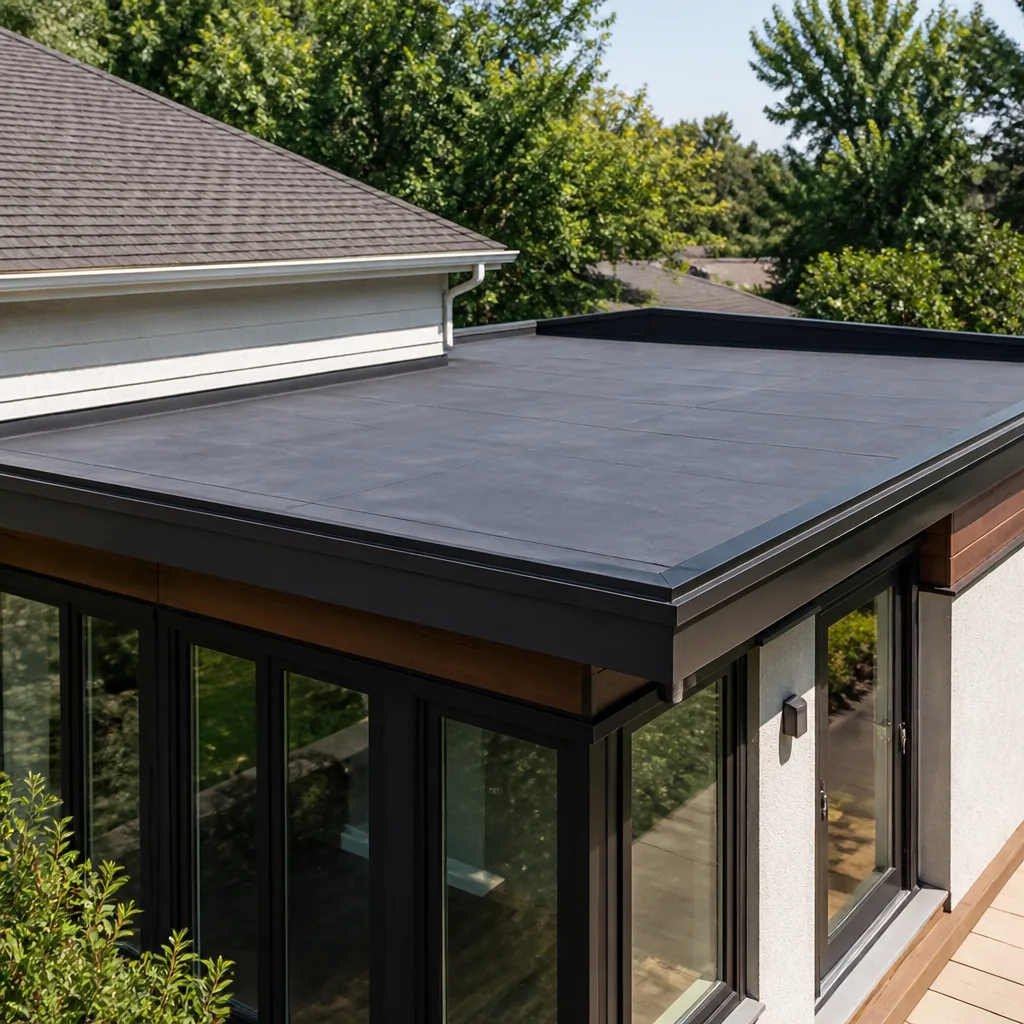
Flat roof repair in Corona is a different discipline from tile work, and it’s one we handle regularly because a meaningful share of Corona’s older North Corona homes and a number of mid-century commercial conversions in the city carry flat or low-slope roof sections, often on additions, garages, and carports where original built-up or modified bitumen membranes have hit the end of their service life. The inland heat here is brutal on these systems: temperatures over 105°F bake the membrane, and the seams pull apart over time.
Common Flat Roof Failures We Find
In Corona, the usual culprits are split seams from thermal expansion, ponding water at low spots, and failed flashing where the flat roof meets a pitched tile section or a chimney. We inspect the whole membrane before patching, because a small tear at the surface often means the underlying membrane has dried and cracked across a wider area. Repair costs in Corona typically run $500-$1,200, depending on how far the membrane has deteriorated.
What We Use and Why
For patchwork, we use materials from leading manufacturers including GAF and Tamko, matched to the existing system so the repair bonds correctly. If the membrane is too far gone, we’ll tell you plainly – sometimes a patch buys two years and sometimes it buys six months. We’ll show you the condition and let you decide, with the numbers in writing before anything is opened up. Call (945) 303-9821 to schedule a flat roof inspection in Corona.
Shingle Roof Repair in Corona
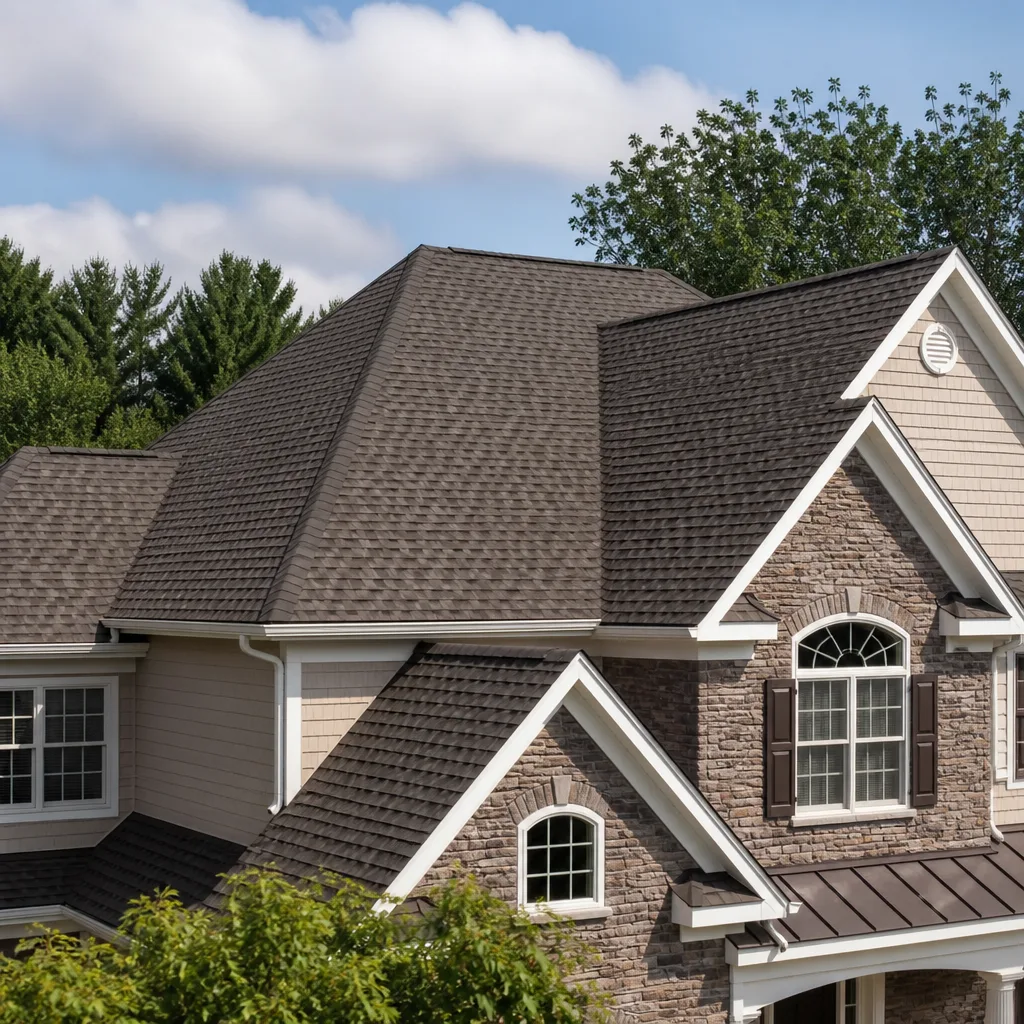
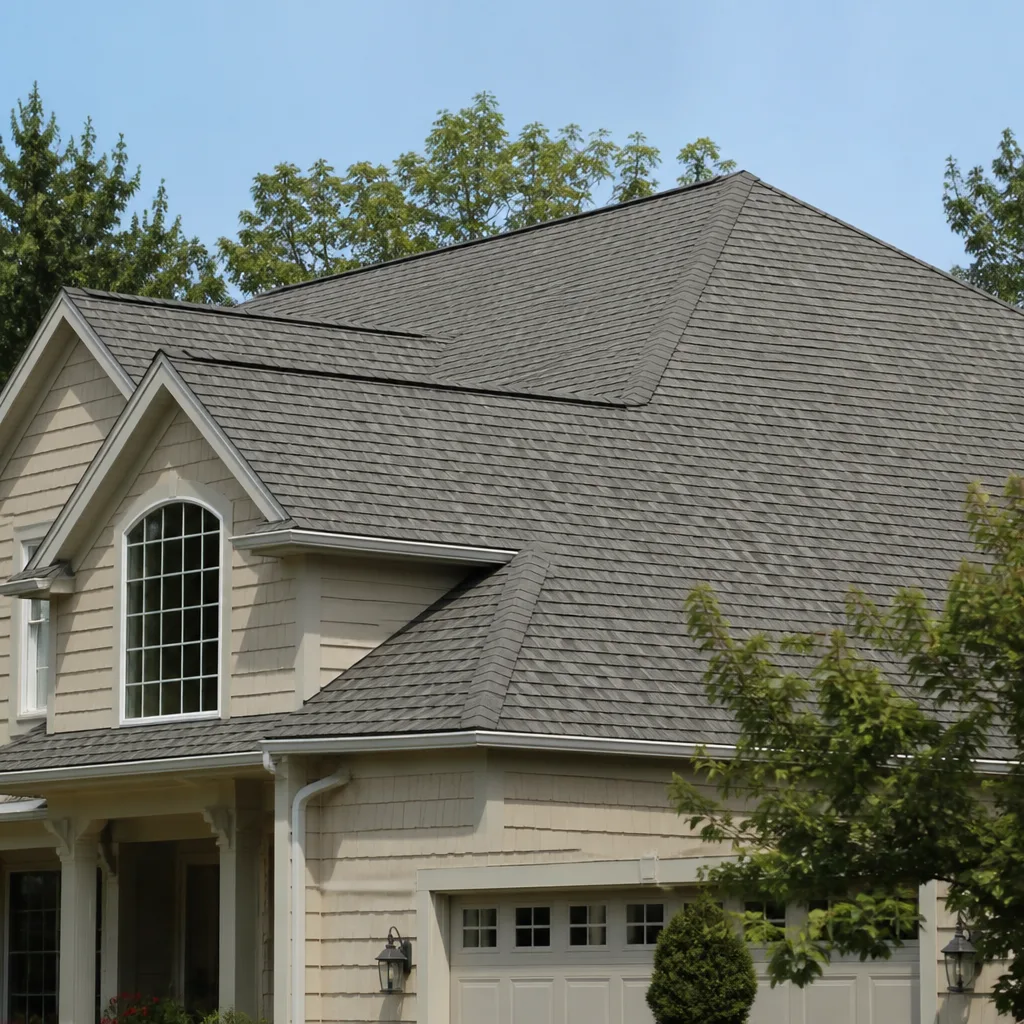
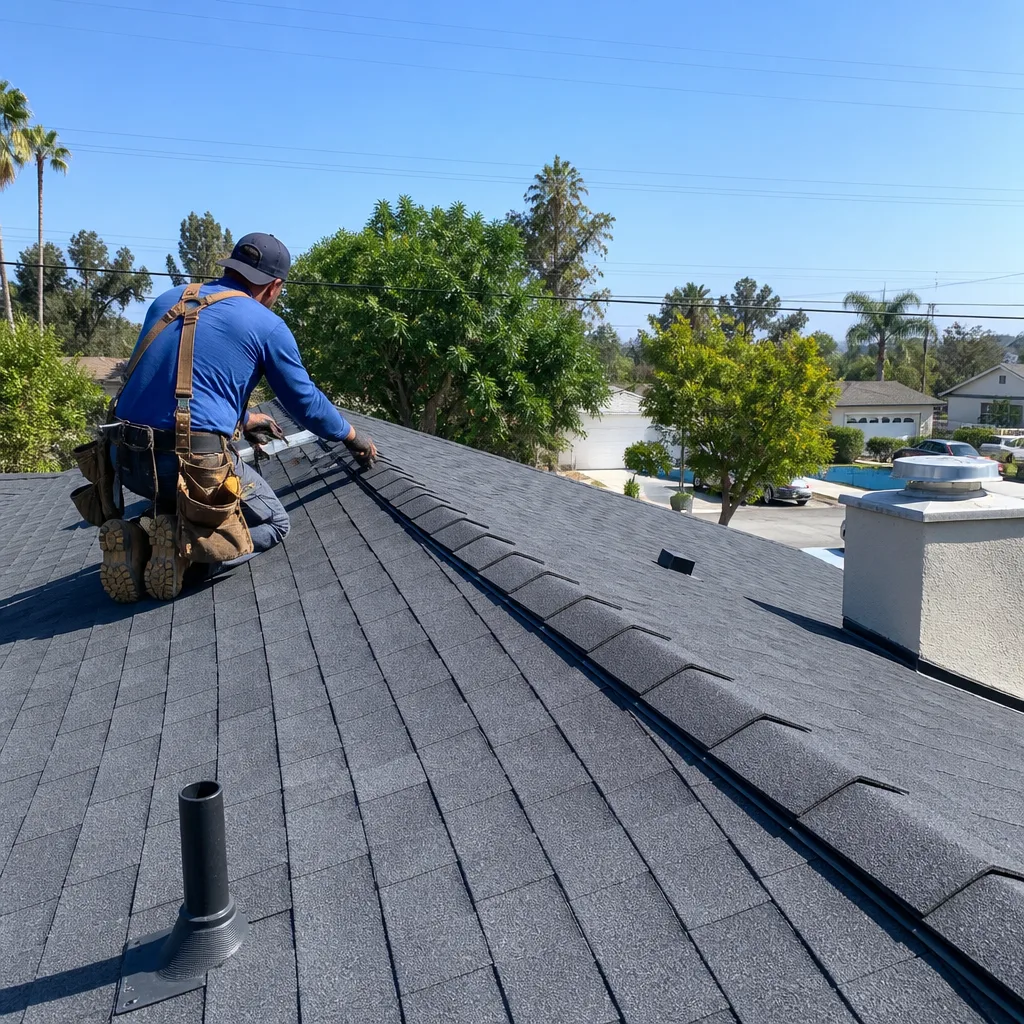
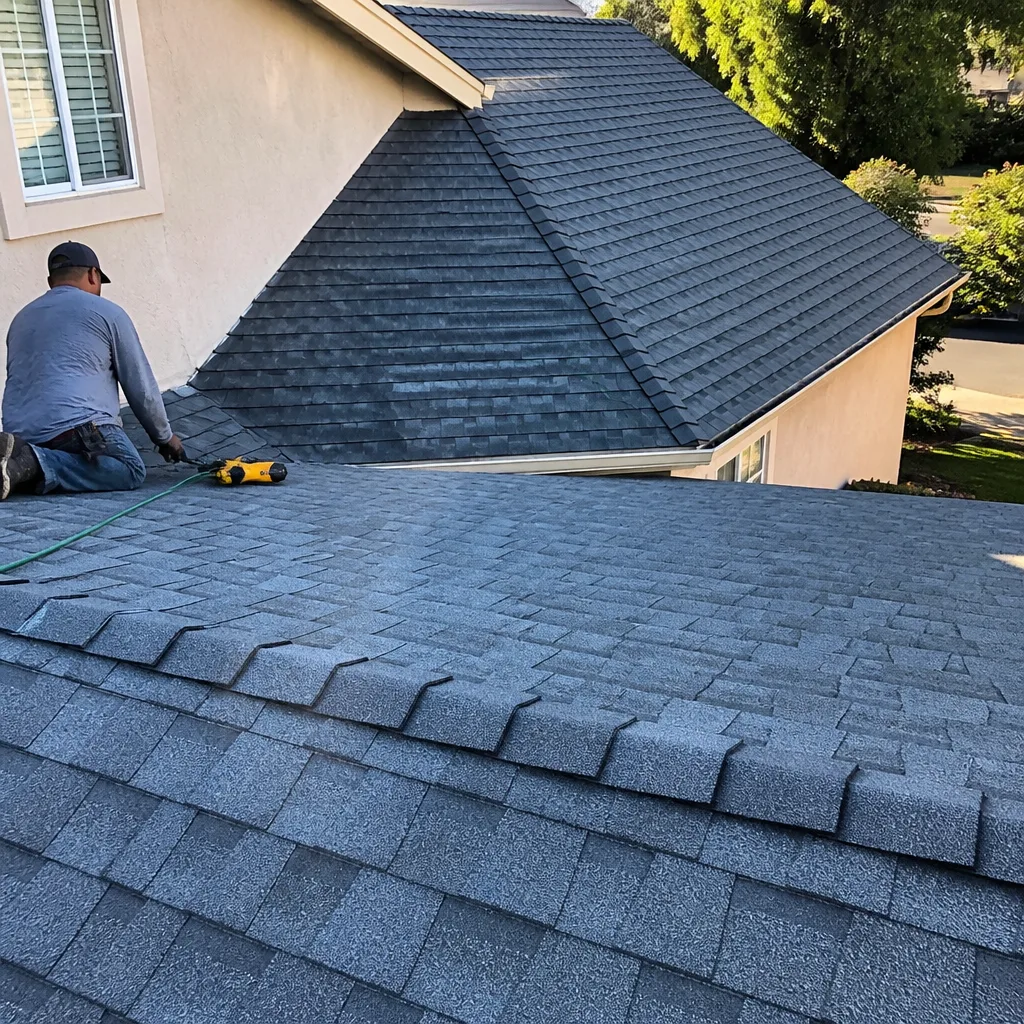
Shingle roof repair in Corona comes up more often than people expect, because while South Corona and Sycamore Creek are tile country, plenty of older North Corona neighborhoods built in the 1960s and 1970s still carry original or early-replacement asphalt shingles. Some of those roofs are now 35 to 50 years old. Intense UV from Corona’s inland sun turns shingles brittle and chalky, and when shingles lose their granular surface, the fiberglass mat below is exposed and the roof begins to fail systematically.
What We Usually Find on Corona Shingle Roofs
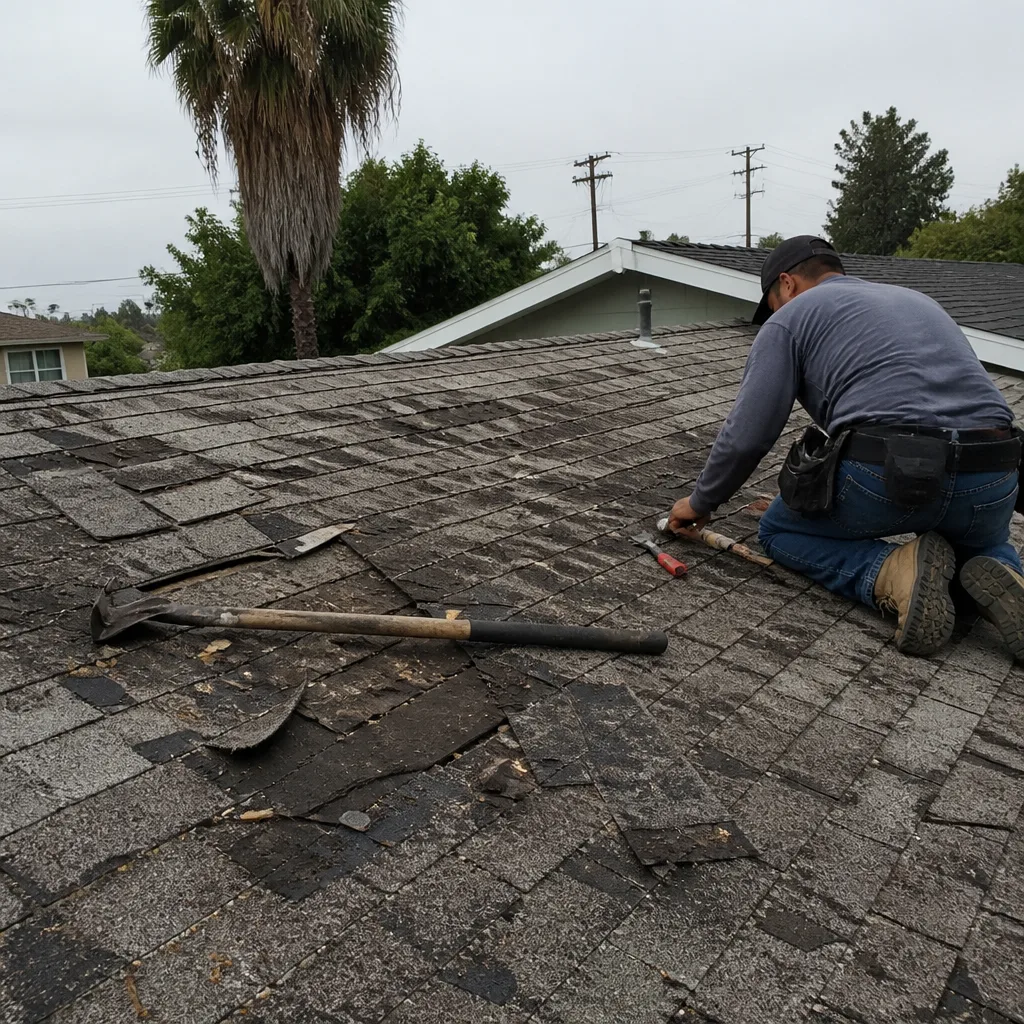
Missing or cracked shingles after Santa Ana wind events are the most visible issue, and we replace those quickly, normally for $350-$650 when the damage is localized. But the more serious problem is widespread granule loss and nail pops across the field of the roof, which means the shingle system is nearing the end of its serviceable life. When we probe those roofs, we often find the decking is still sound underneath.
Vent Boots, Valleys, and Drip Edge
Vent boot repair and valley repair are the two shingle-related fixes we do most in Corona after storm events. A cracked neoprene vent boot around a plumbing stack will let water run straight down the pipe chase and into the ceiling – that’s a $250-$450 repair when the flashing itself is the only problem. Valley metal that has rusted through or been lifted by wind can channel water under the shingles on both slopes; those repairs typically run $400-$800 depending on valley length. If the drip edge is corroded, water wicks back into the fascia and soffit – and that’s a problem that shows up first as peeling paint, not a ceiling stain.
Trusted Brands We Service in Corona
Tilehurst Roofing gives Corona homeowners a genuine choice of material, not whatever happens to be on the truck. We service and install roofing systems from seven major manufacturers: GAF, CertainTeed, Owens Corning, IKO, Atlas, Tamko, and Boral. For tile repairs in Corona’s tract-home subdivisions, we commonly match Atlas and Boral profiles, and for shingle work we stock GAF and Tamko components locally so repairs don’t wait on out-of-state shipping. If your existing roof is one of those systems, we can match it. If it’s something else, we’ll tell you what we can do and what we can’t.
Common Roof Repair Problems We See in Corona Homes
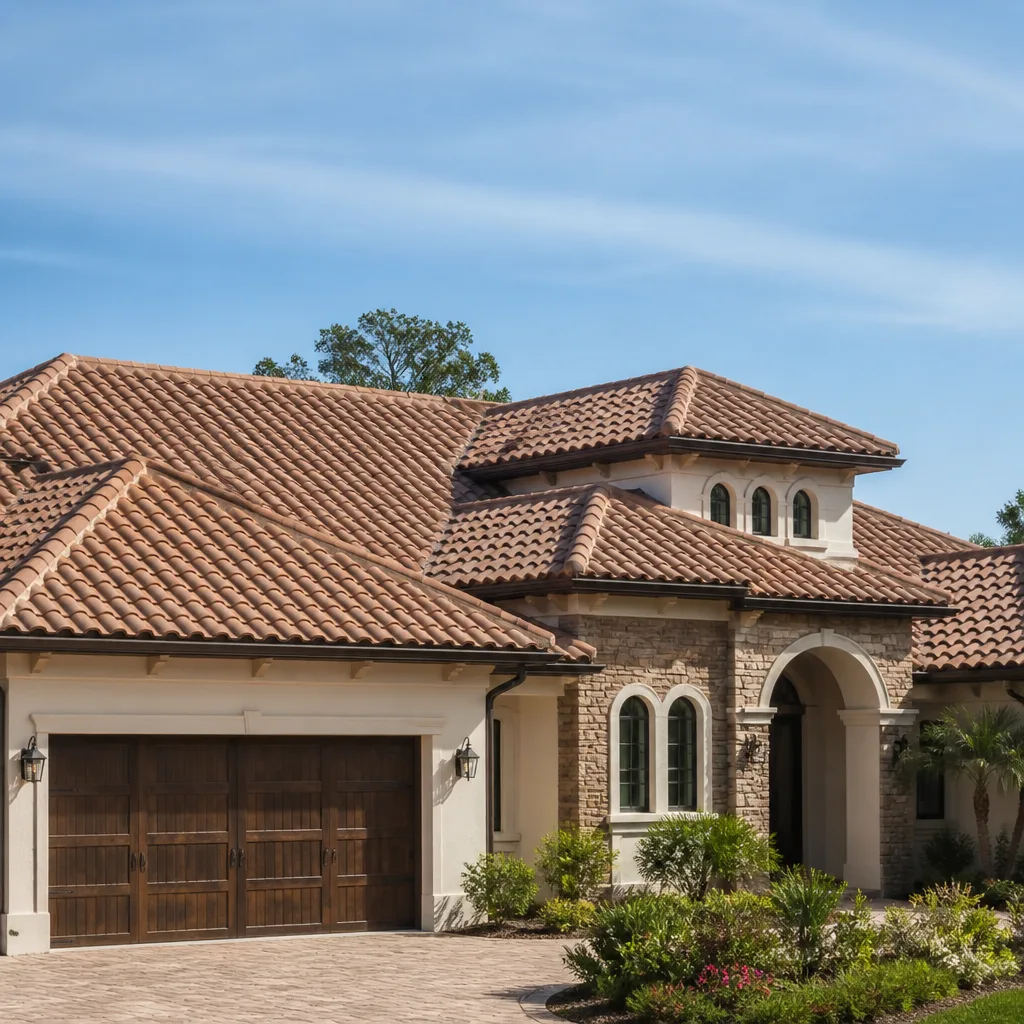
- Chalked, torn underlayment under intact tile. Corona’s 1988-2008 tile tracts were built almost uniformly with 15-lb felt underlayment, and after 15 to 35 years of inland heat, that felt turns brittle, chalks, and tears. Water reaches the decking while the tiles above still look fine, and by the time a ceiling stain appears, the sheathing is already soft.
- Eave decking rot at the drip edge and fascia. The heat that chalks the felt from below is the same heat that evaporates moisture upward, so the deck edge at the eave courses rots before any interior leak shows. Roofers who know South Corona subdivisions probe there first – it’s the most common hidden failure in the city.
- Cracked ridge-cap mortar and blown-off caps from Santa Ana winds. Corona sits at the western edge of the Inland Empire, directly downwind of the Temescal Canyon and Santa Ana Mountains passes. When gusts exceed 60 mph, ridge caps crack at the mortar joints or lift off entirely, and the next rain goes straight into the attic.
- Thermal cycling stress on tile fasteners. Summer highs over 105°F expand and contract the concrete tile, and over years the fasteners back out and mortar cracks at hips and ridges. The roof survives the heat fine – it’s the cycling between the 105-degree day and the 60-degree night that works everything loose.
Pricing for Roof Repair in Corona, CA
Here are honest numbers for Corona’s market, based on what we actually charge. Leak repair ranges from $350 to $900 depending on whether the water is coming through a single penetration or through failed underlayment across a broader section. Flashing repair around chimneys, skylights, and walls typically runs $400 to $950. Flat roof patches run $500 to $1,200. Replacing underlayment on a section of a tile roof runs $900 to $2,500, depending on how much tile must be lifted and reset and whether decking needs to be sistered or replaced. Shingle replacement on a small, localized area is $350 to $650; valley repair is $400 to $800.
Every quote you get from Tilehurst Roofing is a written line-item price, and it stays the written price. No change orders unless you approve them in writing first, and no “we found something” conversation that ends with a higher number you never agreed to. Call (945) 303-9821 to schedule a free estimate – we’ll walk your roof in Corona, show you what we find, and put the numbers in your hands.
We Also Serve Cities Near Corona
Our Roof Repair crews regularly work in Norco, Chino, Chino Hills, and Irvine, and we bring the same written-pricing and written-guarantee standard to every job in Corona. If you’re a few miles outside the city line, call (945) 303-9821 anyway – we’ll tell you straight whether we can get a truck to your street.
Serving Corona, CA - Our Local Coverage Area
We’re based in the Corona area and know this community well. Use the map below to see our service coverage - if you’re nearby, we can almost certainly help.
FAQs About Roof Repair in Corona
The leak is almost always the underlayment, not the tile. In Corona’s 1988-2008 tract-home subdivisions, the original 15-lb felt underlayment chalks and tears from decades of inland heat while the concrete tiles above still sit properly and look intact. Water gets through the failed felt, saturates the decking, and rots the eave courses before a ceiling stain appears. If you live in South Corona or Sycamore Creek and your roof is over 20 years old, this is the most likely explanation. Call (945) 303-9821 and we’ll probe the eave courses first – that’s where the truth shows up.
For minor repairs – replacing a few shingles, resetting a ridge cap, sealing a penetration – Corona generally does not require a permit. But when a repair opens up more than a certain area of decking, or when we’re replacing underlayment on a tile roof section, a permit can be required, and here’s what matters: the moment the inspector looks at an open roof, the code upgrades start. If the decking is rotted and we’re opening the roof anyway, the inspector may require clips, nailing patterns, or underlayment specs that the original 1990s build never had. We handle that by inspecting first, writing any code-driven escalation into the contract as an allowance before we start, and pricing any surprises in writing for your approval before we touch them. You’ll never get a surprise bill for a code upgrade you didn’t authorize.
Corona sits directly downwind of the Temescal Canyon and Santa Ana Mountains passes, and that geography makes this city a funnel for the strongest Santa Ana gusts in the Inland Empire. Ridge caps crack at the mortar joints, caps blow off, and tile fasteners that were already loosened by thermal cycling let go entirely. After any wind event over about 50 mph, it’s worth having someone walk the roof. We do that inspection free, and the repair itself is a written number before we start.
Ask these four questions: Will you put the price in writing before work starts, and is that the final price? Will you probe the underlayment at the eave courses, not just look at the tiles from the ground? If the repair fails inside a year, do you come back at no charge – and will you put that in writing? And if the inspector requires a code upgrade once the roof is open, who pays for it? If the roofer hesitates on any of those, keep looking. Tilehurst Roofing answers all four with a written document before the crew starts, and Greg Holloway’s crews work under the 365-Day Done Right Promise: if it’s not done right, we make it right for a full year.
We repair flat, shingle, and tile roofs. Corona has more tile than anything else, but older North Corona neighborhoods have plenty of shingle roofs from the 1960s and 1970s, and flat sections show up on additions, garages, and carports all over the city. Different materials, same standard: written price first, written guarantee before the crew leaves, and a live person on the phone whenever you call (945) 303-9821.
Written by Greg Holloway, Roofing Lead at Tilehurst Roofing, serving Corona’s tile tracts and older neighborhoods with written prices and written guarantees on every repair.